Container shipping is adding capacity faster and in larger vessels. The operational question for ports is how vessel control and towage keep pace.
Summary
BIMCO expects global container fleet capacity to reach 34 million TEU after a few more newbuild deliveries. At the start of September, the fleet was only 8,000 TEU short. The milestone would put growth at 10 million TEU, or 42%, in 5.5 years. [S1]
Ports should look beyond the total. Ships above 12,000 TEU supplied two-thirds of the capacity added since early 2021. Their share of fleet capacity rose from 30% to 40%, while the average containership grew by 14%. [S1]
Fleet capacity does not set a port’s tug requirement. That depends on the vessel, waterway, weather, traffic and manoeuvre. But the trend is clear: a growing share of container capacity sits in larger vessels, leaving less room to treat towage as an afterthought.
Key takeaways
- The global container fleet is set to reach 34 million TEU after a record 42% expansion in 5.5 years. [S1]
- Ships above 12,000 TEU produced two-thirds of the new capacity, increasing the operational relevance of precise control over large vessels. [S1]
- Nearly 2,000 ships are now at least 20 years old, pointing to a substantial renewal and recycling decision window. [S1]
- Liner operators control 65% of capacity, up from 57%, strengthening the case for reliable, scalable towage relationships at recurring ports of call. [S1]
- A U.S. Coast Guard inquiry found that all 11 assessed port areas were receiving larger commercial vessels, while bridge allision was the leading worst-case scenario. [S5]
- Normal Suez Canal routings could release capacity now absorbed by Cape diversions. This is a planning uncertainty, not a forecast of a specific port’s traffic or tug requirement. [S1]
What the 34 million TEU milestone changes
The 34 million TEU threshold is close. BIMCO expects it to be crossed after only a few of the 46 vessels scheduled for September delivery enter service. Together, those vessels represent 286,000 TEU. [S1]
For a port, capacity is more than a market statistic. Larger ships bring more windage, momentum and berthing energy into a manoeuvre. Their calls also put more cargo and schedule exposure on fewer assets. The International Transport Forum has warned that mega-ships put pressure on access channels, terminals and hinterland systems. [S3]
The U.S. Coast Guard’s 2026 Board of Inquiry gives that pressure a more immediate operational context. The Board assessed 11 U.S. port areas and found that stakeholders consistently reported receiving larger commercial vessels over the previous decade. Bridge allision was identified as a worst-case scenario at eight of those ports. [S5]
The report is specific to the United States and does not prescribe one tug arrangement for every port. It does show why vessel growth needs to be assessed against the infrastructure that lies along the transit, including bridges, channels and terminals. The Board called for stronger waterways risk assessment and more collaboration with port stakeholders. [S5]
No universal tug-power requirement follows from the fleet data. A well-protected berth, a constrained approach channel and an exposed river transit pose different control problems. When a port’s normal vessel envelope changes, its control system needs review before those calls become routine.
Towage is part of the control system
The International Maritime Organization treats adequate tug assistance as part of maritime and port safety. Its guidance is addressed to port authorities, port operators, pilot organisations and tug services. [S2]
The assessment needs to focus on the force and control required in the conditions of the operation. Static bollard pull is a useful reference, but it does not show how much force a tug can apply while positioning around a moving vessel in wind, current and confined water. For larger vessels, the operational question is dynamic bollard pull: how much control remains available when the manoeuvre demands it.
The Coast Guard’s Board recorded increased tug capacity and tug escort requirements as a mitigation raised by stakeholders at four of the assessed port areas. [S5] That is not a universal Coast Guard requirement. It is evidence that ports facing different local constraints are putting tug capability and escort arrangements back into the risk discussion.
As vessel profiles change, harbour masters, pilots and towage operators need answers to four practical questions:
- What steering, braking and holding margin is required at the critical points of the approach and berth?
- Which wind, current, tide and visibility limits remain acceptable for the new vessel class?
- What capability is available if propulsion or steering is lost at the least forgiving location?
- Are pilots, tug masters, terminals and vessel operators working to a shared, tested operating envelope?
Fleet data cannot settle these questions. Local tests and operating limits do. But delay is harder to justify.
Fleet renewal and service partnerships
Low recycling has helped drive the recent fleet expansion. SWZ Maritime reports that fewer than 300,000 TEU were recycled in the past 5.5 years. Nearly 2,000 ships, representing more than 5 million TEU, are already at least 20 years old and are expected to reach or pass the historical average recycling age of 25 within five years. [S1]
Fleet renewal creates a decision point for shipowners, ports and towage operators. BIMCO’s figures say nothing about the fuel owners will choose. Hybrid, battery-electric and alternative-fuel tug configurations need to be tested against each port’s operating profile and energy infrastructure, not assumed from a market-wide trend.
Liner operators accounted for 85% of the 10 million TEU added since early 2021 and now control 65% of global container capacity. [S1] For towage providers, this changes the commercial picture as well as the technical one. Fewer, larger operators will bring concentrated capacity through recurring port calls. When disruption affects a larger share of a carrier’s network, reliable service, clear operating standards and the ability to scale matter more.
Planning for Suez normalisation
The order book already holds more than 14 million TEU for delivery by the end of 2030. Depending on recycling, the fleet could reach 44 million TEU within five years. [S1]
A return to normal Suez Canal routings would release capacity now absorbed by longer diversions around the Cape of Good Hope. [S1] BIMCO provides no forecast for individual port calls. Network deployment can still shift faster than a conventional port-investment cycle allows for.
Ports need the ability to revisit vessel limits, tug allocation and contingency plans as commercial patterns shift. A berth or channel approval should not freeze those decisions.
Novatug’s relevance
The independent sources establish fleet growth and the need to assess tug assistance. Novatug’s product case starts where that evidence ends.
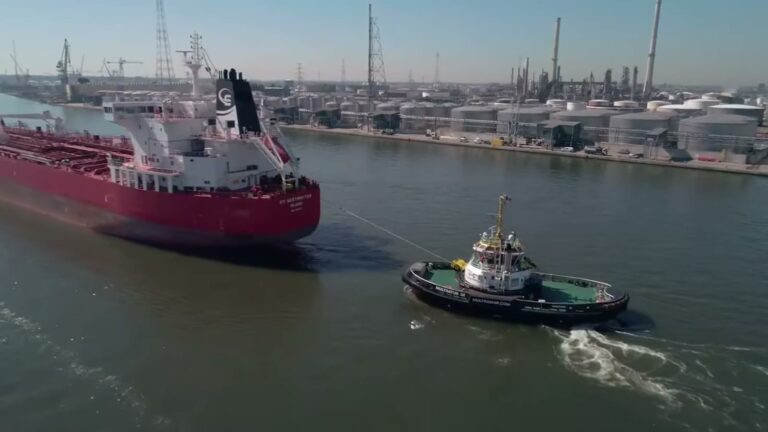
Novatug’s position is that advanced towage can act as floating infrastructure. It can add control over large vessels and extend the useful operating capacity of existing port infrastructure. The Carrousel Rave Tug has a patented freely rotating towing point. Novatug positions it as a way to provide dynamic bollard pull and enhanced vessel control.
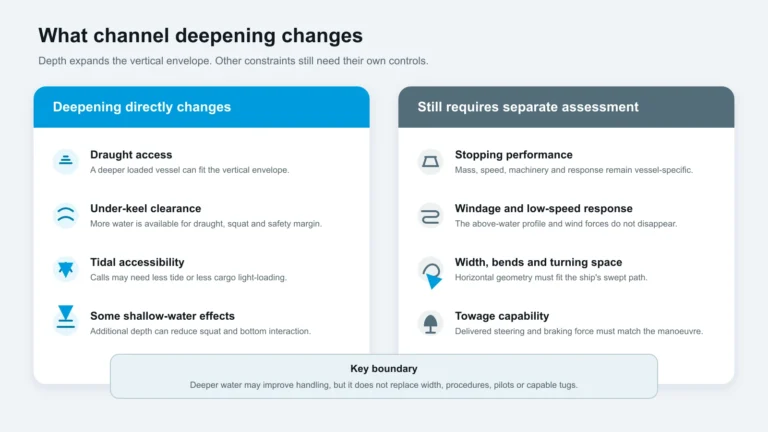
The case is for a wider infrastructure assessment. Civil works remain necessary, and no single tug solution will suit every port. A deeper channel solves the depth issue. It cannot control a larger vessel in a live manoeuvre.
Novatug is also exploring a fully electric regenerative CRT concept with a potential partner. It has not been commercialised as a zero-emission product. Fleet renewal makes that work more timely.
Frequently asked questions
Does a 34 million TEU fleet mean every port needs bigger tugs?
No. Fleet capacity does not determine local tug requirements. Those depend on the vessel, waterway, berth, weather, traffic, pilotage practice and the manoeuvre. The data supports reassessing these conditions as the vessel mix changes. [S1][S2]
Why does the share of ships above 12,000 TEU matter?
Those ships accounted for two-thirds of capacity added since early 2021, increasing their share of global capacity from 30% to 40%. [S1] Larger vessels can change the control demands placed on a port, so their increasing role is a reason to test operating margins rather than rely on historic assumptions.
Did the Coast Guard require more tug capacity or tug escorts at every U.S. port?
No. The Board recorded increased tug capacity and tug escort requirements as local mitigations raised at four of the 11 port areas it assessed. It did not issue a universal tug requirement. [S5]
Does fleet renewal guarantee cleaner shipping or cleaner towage?
No. The BIMCO figures identify a potential recycling cohort, not the fuel or propulsion choices that will replace it. Cleaner vessel and tug configurations should be assessed against local operations, energy supply and economics.
What should a port review before accepting a larger vessel class?
Review the complete operating envelope: channel and berth geometry, wind and current limits, pilotage, traffic, communications, contingency scenarios and tug capability. The assessment must be specific to the port and manoeuvre. [S2][S3]
Sources
- [S1] SWZ Maritime, reporting BIMCO, Container fleet set to reach new high of 34 million TEU, 2026.
- [S2] International Maritime Organization, Ship/Port Interface: Availability of Tug Assistance, 2021.
- [S3] International Transport Forum at the OECD, The Impact of Mega-Ships, 2015.
- [S4] Novatug, Carrousel Rave Tug.
- [S5] U.S. Coast Guard, Board of Inquiry Report: Ports and Waterways Safety Act Inquiry, 2026.
Related reading
- The Cascade Is Already at Your Berth
- Why Dredging Alone Does Not Solve the Mega-Ship Problem
- Static vs Dynamic Bollard Pull: What Escort Towage Needs to Show
- Explore the Carrousel Rave Tug
If your port is reviewing a new vessel class or operating envelope, contact Novatug for a port-specific discussion of vessel control and towage capability.