Assess the operation
Define the assisted vessels, port geometry, manoeuvres, availability, environmental conditions and operational profile.

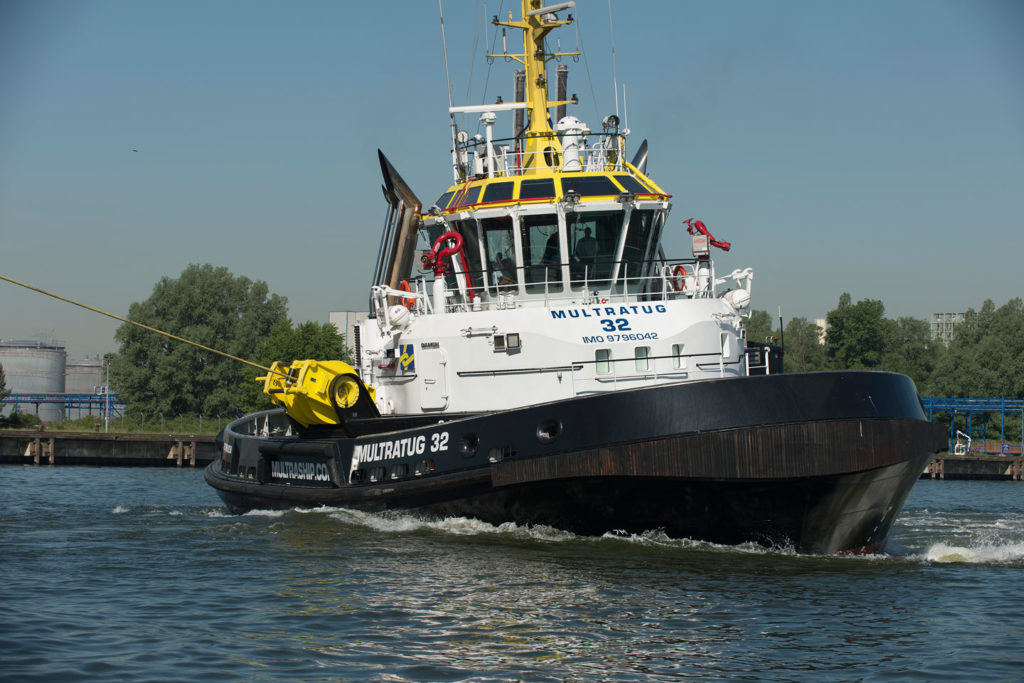
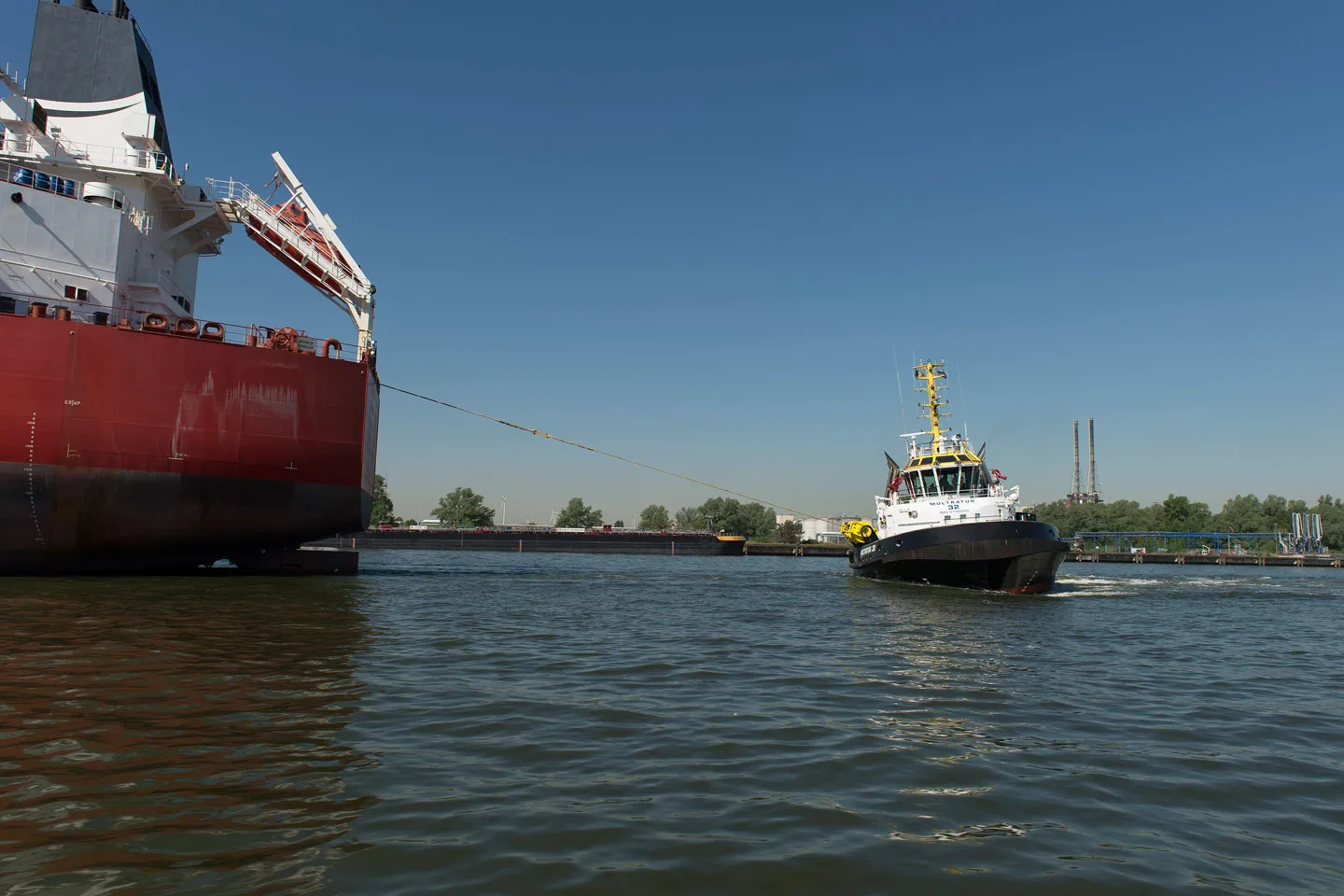
Multratug 32 is a CRT-L reference vessel. Its patented towing ring means the tug cannot capsize under transverse towline load.
Multratug 32 delivers 180 tonnes of dynamic bollard pull from a tug with a 70-tonne static rating. The CRT harnesses the flow of water around its hull to generate braking and steering force while assisting a moving vessel.
The global tugboat fleet is aging fast. The average active tug is 15.2 years old, while the US sea-going fleet averages 35.9 years. This signals a massive fleet renewal cycle — the perfect time to upgrade to CRT technology.
Multratug 32 and Multratug 33 have completed a combined 6,000 jobs across Antwerp, Vlissingen and Terneuzen. Excluding tests done in various big ports over the years.
Combined operational total as of August 2026.
| Call Sign | PBQM |
| Year Built | 2018 |
| IMO | 9796042 |
| Flag | Dutch |
| Homeport | Terneuzen, Netherlands |
| Classification | Bureau Veritas ✓ Hull, Machinery, Escort Tug, Unrestricted Navigation |
| Length Overall | 31.90 m |
| Beam Overall | 13.20 m |
| Maximum Draft | 6.30 m |
| Air Draft | 16.60 m |
| Gross Tonnage | 494 tons |
| Net Tonnage | 148 tons |
| Maximum Static Bollard Pull | 70 tons |
| Dynamic Bollard Pull | 180 tonnes |
| Maximum Speed | 14.1 knots |
| Main Engines | 2× ABC 12VDZC |
| Total Power | 5,300 kW at 1,000 RPM |
| Propeller Type | 2× Voith Schneider VSP 32R5EC/250-2 |
| Total Capacity | 2,700 m³/hr |
| Monitors | 2× 1,200 m³/hr (water/foam) |
| Water Spray | 1× 300 m³/hr |
| Carrousel System | CTS-250 |
| Towing Winch | CRT 200 (20t pull at 10 m/min) |
| Brake Capacity | 200 tons |
| Aft Towing Hook | GSH-65 |
| Capstan | DMT AMC-E22 K2 |
| Deck Crane | Palfinger PK4501M (1,000 kg / 4.5 m) |
| Generator Sets | 3× Volvo D5A-T (70 kW each) |
| Voltage | 400V, 50Hz |
| Fuel Oil | 144 m³ |
| Fresh Water | 14.4 m³ |
| Lubrication Oil | 5.4 m³ |
| Foam | 20.2 m³ |
| Dirty Oil / Sludge | 5.8 m³ |
| Bilgewater | 5.8 m³ |
| Grey Water | 8.6 m³ |
| Sewage | 8.6 m³ |
| 1-Man Cabins | 2 |
| 2-Men Cabins | 2 |
| Mess Room | 1 |
| Galley | 1 |
| Length Overall | 25.50 mExcluding fendering |
| Breadth, Moulded | 12.00 m |
| Depth, Moulded | 5.10 m |
| Scantling Draft | 4.34 m0.85 D |
| Design Draft | 3.50 m above baseline |
| Navigational Draft | 3.70 m above baseline |
| Bollard Pull, Ahead | 50 tonnesTo be confirmed by Voith |
| Free Running Speed, Ahead | 12.4 knotsEstimated by model tests |
| Free Running Speed, Astern | 11.9 knotsEstimated by model tests |
| Fuel Oil | 74.4 m³ |
| Urea | 5.0 m³ |
| Fresh Water | 9.7 m³ |
| Lube Oil | 1.8 m³ |
| VSP Oil | 1.8 m³ |
| Sludge | 3.6 m³ |
| Oily Water | 3.6 m³ |
| Sewage Tank | 3.4 m³ |
| Grey Water Tank | 3.4 m³ |
| Foam | 21.1 m³ |
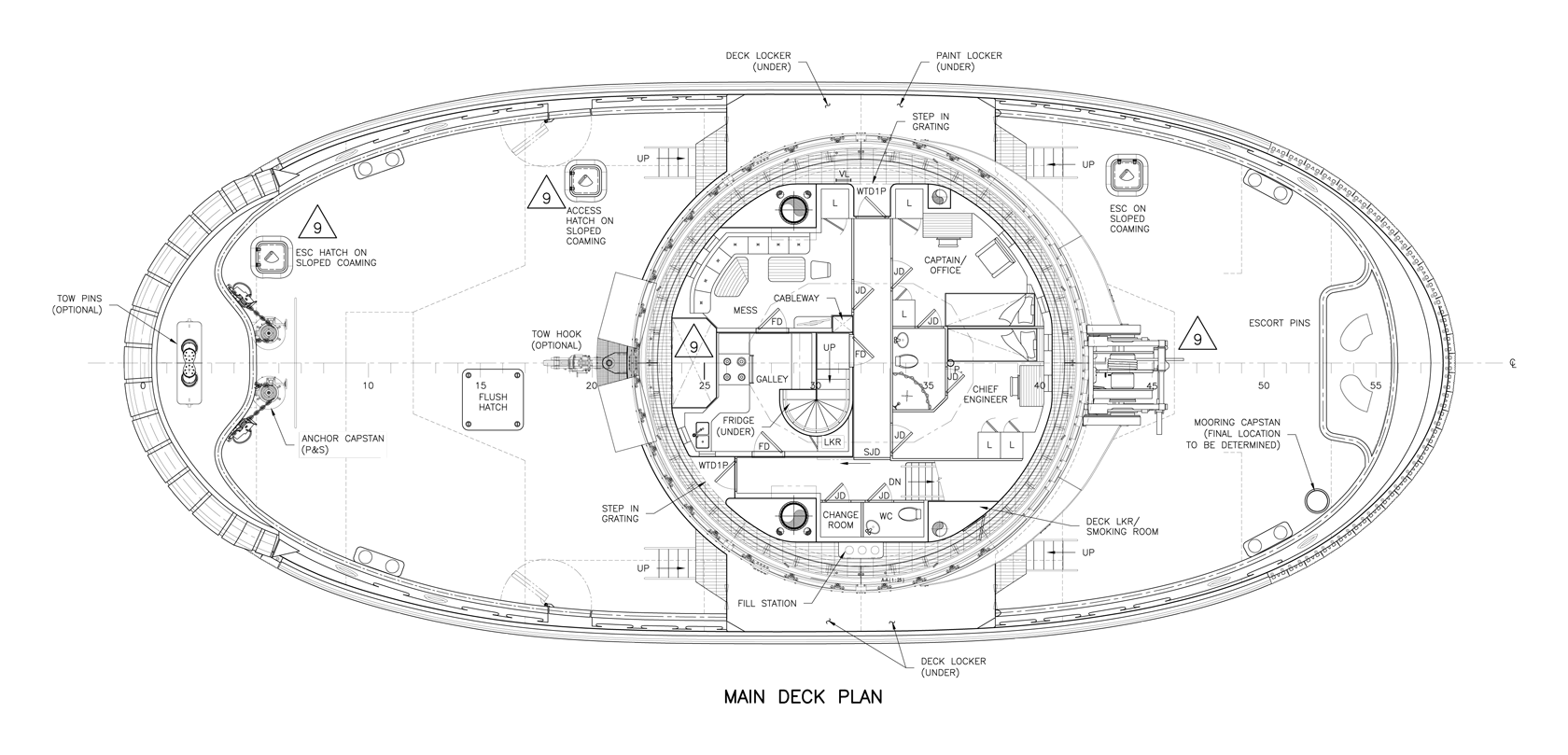
Top-Down Profile
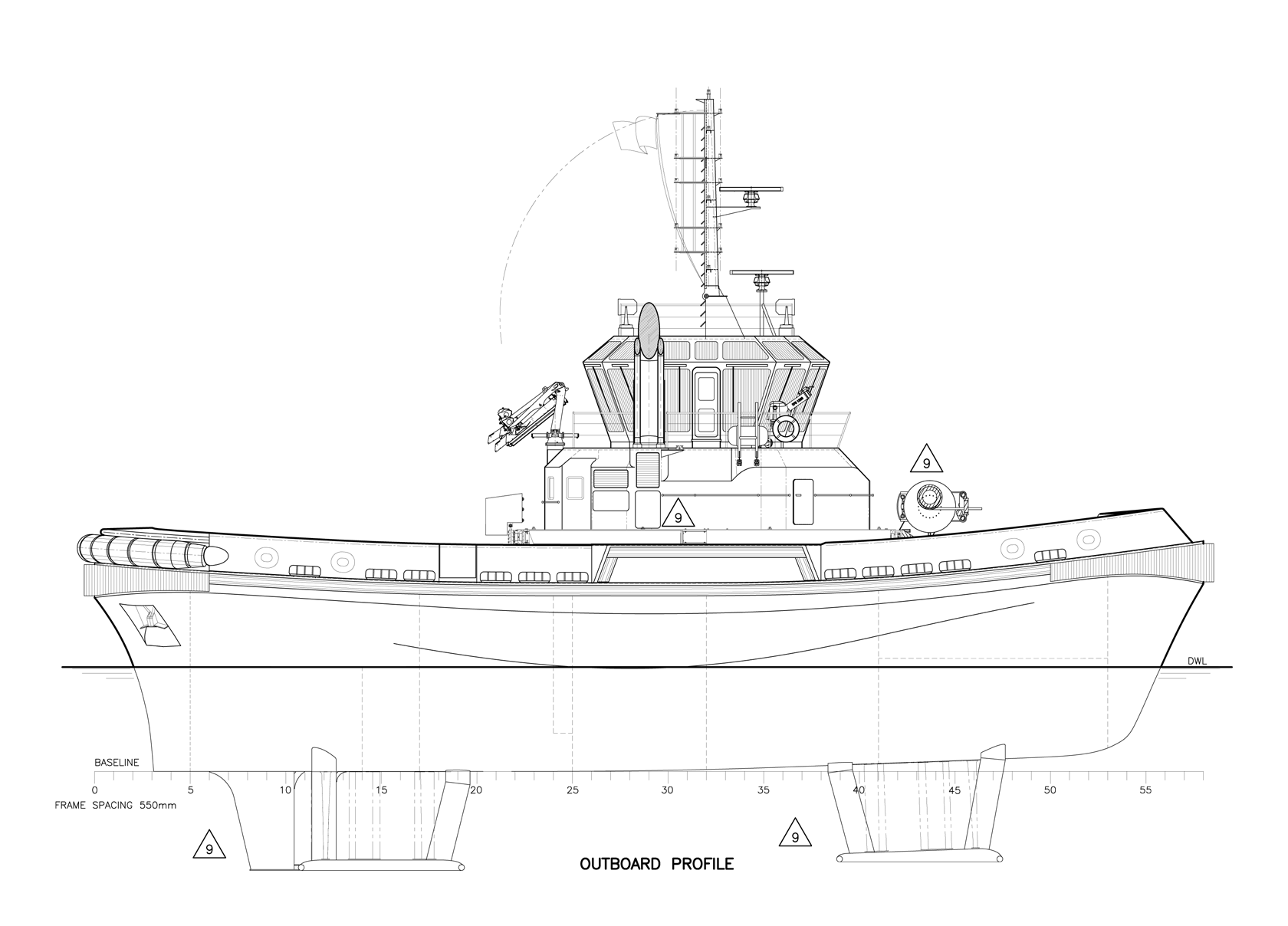
Outboard Profile
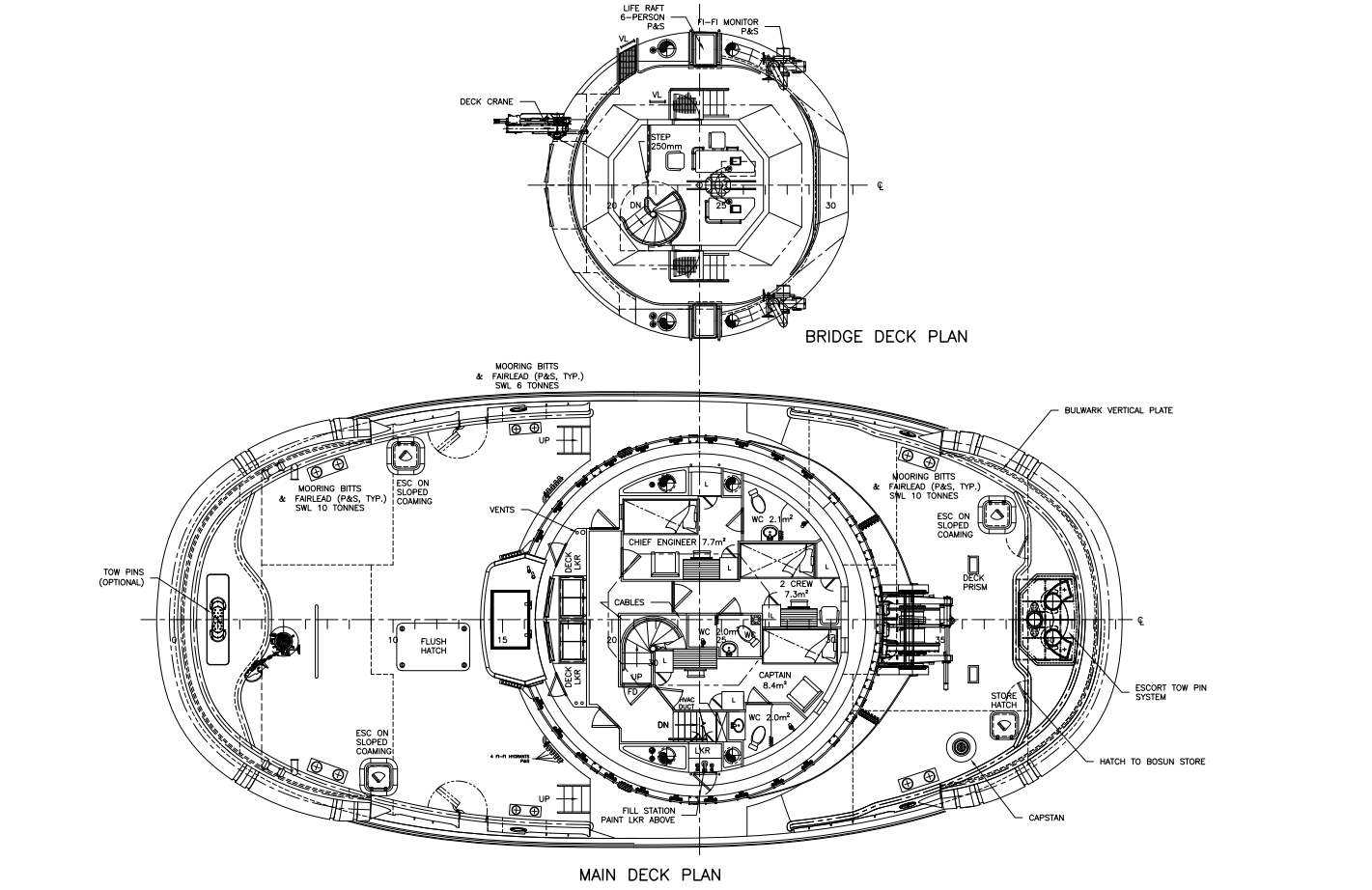
Main Deck Plan
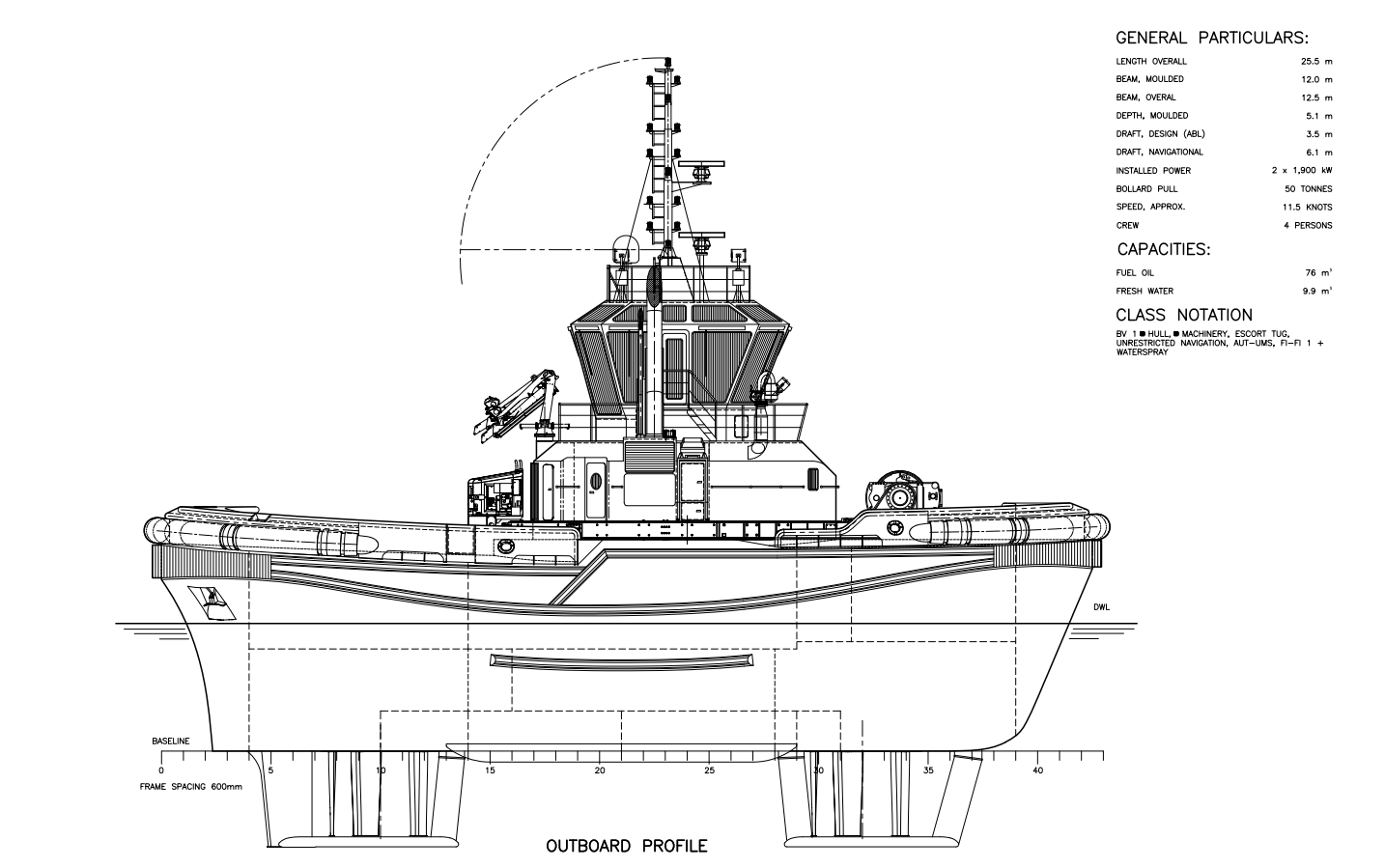
Outboard Profile
Novatug develops and coordinates complete Carrousel Rave Tug newbuilds for long-term deployment. Each project starts with the port, assisted vessels, duty cycle, weather conditions and required energy profile.
The towage operator provides the crew and manages daily operations. Novatug coordinates vessel configuration, design partners, construction, financing and the training needed to use the CRT effectively.
Define the assisted vessels, port geometry, manoeuvres, availability, environmental conditions and operational profile.
Configure the established CRT-L or develop a smaller purpose-built CRT around the required capability and duty cycle.
Combine feasibility work with visits to the two CRTs in service and dedicated scenarios in the Terneuzen full-mission simulator.
Novatug coordinates the naval architecture, propulsion, winch engineering, shipyard and project partners through delivery.
Training covers effective CRT handling, towage coordination and operation-specific scenarios before and after entry into service.
Novatug works with financing partners to structure multi-year CRT deployment. Ownership may remain with Novatug or a financing partner. Depending on the project, the structure can include financing, maintenance, technical support, insurance, dry-docking and crew training.
A battery-electric CRT can be developed jointly. Because the CRT can use hydrodynamic lift to generate towline force, lower operating power demand can reduce the battery capacity required for round-the-clock service. The final configuration is determined from the actual operating profile.
“The CARROUSEL RAVE TUG is not just a tug. It is floating infrastructure.”
By adding steering and braking authority during an assist, the CRT addresses the vessel-control constraint directly. This can help ports extend the useful capacity of existing channels, turning basins and berths without treating fixed works as the only response.
These accounts were originally published in Novatug's June 2019 whitepaper and have been approved for reuse.
“For me as a captain, this means that the work is easier because the tug offers more possibilities through its maneuverability. It brings more rest because the risk of capsizing due to towline forces is no longer present.”
“As a captain, I think this is a good way of working because you can perform the maneuver quickly and precisely, which the pilots and captains of the seagoing vessels also appreciate.”
“As soon as the Carrousel system is being used for dynamic braking and steering, the towline forces go up whilst the power consumed stays low.”
“The actual measured difference over the charter period was an average of 260 litres per hour on the port's own tugs and 160 litres per hour for the CRT, a 38.5% saving compared with the port tugs.”Measured during a three-month Port of Antwerp charter reported in 2019. Results depend on configuration and operating method.
The Carrousel Towing System features a freely rotating steel ring around the hull. When transverse towline forces increase, the towing point moves down in height, decreasing the arm of the heeling force. This physical mechanism makes capsizing under towline load impossible — a fundamental safety advantage over conventional tugs.
The CRT uses the hull's hydrodynamic lift for braking and steering, so suitable dynamic maneuvers can require less engine power. Internal Novatug testing indicates approximately 30% lower fuel consumption under the tested operating conditions. Actual fuel, emissions and operating-cost results depend on tug configuration, duty cycle and operating method.
Voith Schneider Propellers (VSP) provide instant, omnidirectional thrust control. Combined with the Carrousel system's 360° towing capability, the VSP maximizes maneuverability and responsiveness. This pairing delivers precise control during complex escort and harbor operations.
Despite its innovative performance, the Carrousel Towing System is mechanically straightforward. The rotating ring uses proven bearing technology and requires minimal maintenance. The system integrates seamlessly with standard tug operations — crew training is quick and intuitive.
Where maneuvering room and vessel control are the binding constraints, enhanced control from CRTs may help a port use its existing infrastructure more effectively and defer or avoid some dredging or widening work. Where water depth is the binding constraint, dredging may still be required. In suitable projects, avoided or deferred infrastructure costs can materially strengthen the CRT investment case.
The Carrousel Towing System can be adapted to various hull types and sizes. While initially designed and proven on the Multratug 32, the technology is scalable and can be integrated into new-build tugs of different dimensions and power classes.
Talk with Novatug about vessel profiles, operating requirements, and a practical route toward deployment.
Download the whitepaper Originally published June 2019 Start a technical conversation