The vessel mix can change before the port is ready
The mega-ship challenge is no longer confined to the world’s largest hub ports. When carriers introduce larger vessels on the highest-volume routes, the ships they replace are commonly redeployed to secondary routes. Those displaced vessels, in turn, replace smaller tonnage elsewhere. The International Transport Forum calls this a cascading or trickle-down effect. [S1]
A vessel can arrive before a port’s operating assumptions have caught up. Depth is one part of the review. A larger vessel also changes stopping distance, manoeuvring margins, berthing energy, air-draught constraints, terminal peaks and the demands placed on the people and assets controlling the approach. [S1][S3]
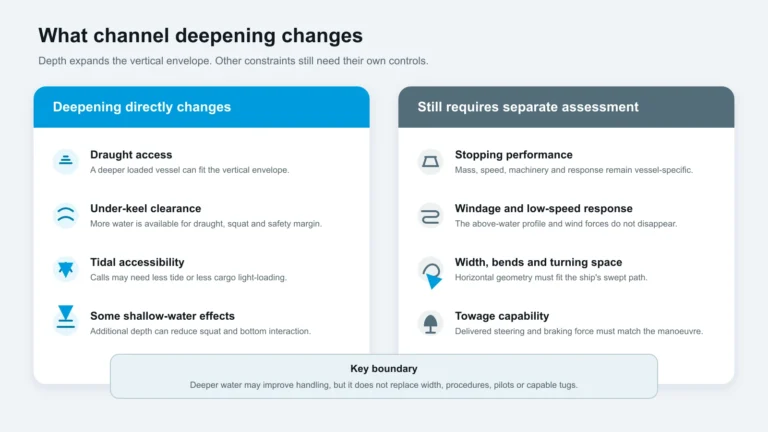
A deeper channel alone does not make the port ready. The port needs to reassess the complete operating envelope: vessel, channel, weather limits, pilotage, traffic management and towage capability.
Illustrative capacity bands showing how larger ships entering main trades can push displaced tonnage through regional and feeder networks. Current market context is supported by [S6], [S7] and [S8]; the graphic is not a route-by-route fleet census.
What changes when ships cascade
- Vessel cascading moves larger ships from primary trade lanes into ports that were not necessarily built around them. [S1]
- Larger vessels create a chain of constraints: channels, bridges, quay walls, cranes, yards, hinterland links and vessel control all matter. [S1]
- Rerouting and congestion can make capacity pressure arrive sooner and less predictably than a conventional infrastructure plan assumes. [S2]
- A port should review towage as part of its control system, not as an isolated service purchased after the vessel call is approved. This is an inference from the cited infrastructure and ship-port guidance. [S1][S3][S4]
- Novatug’s position is that advanced towage can function as floating infrastructure: a way to improve control while fixed works are planned or avoided where they do not solve the underlying control problem. [S5]
Bigger ships do not remain where they first appear
Container lines deploy their newest and largest ships where volumes are highest. That choice does not remove the previous generation from service. It tends to push it outward through the network.
The ITF describes the pattern plainly: ultra-large vessels on the Far East to North Europe route displace smaller units, which move to secondary routes and replace smaller ships again. Its analysis anticipated the effect in regions such as South America and Africa, where ports not originally shaped by the mega-ship trend could still receive much larger calls. [S1]
A port’s risk profile is not set by the maximum vessel named in a long-term master plan. It changes when the normal vessel mix changes. A ship that is manageable at a major hub with a developed channel, extensive tug availability and mature terminal systems may present a different operational problem at a regional port with tighter geometry or less redundancy.
Depth is only one part of the review
The most visible response to a bigger ship is usually dredging. It addresses only part of the system. ITF’s assessment of mega-ships identifies pressure across access channels, bridges, quay walls, cranes, storage yards and hinterland connections. Larger calls also concentrate more cargo into shorter periods, creating operational peaks beyond the ship itself. [S1]
The same logic applies on the water. Harbour approach-channel design is not simply a calculation of depth. PIANC guidance treats it as a navigation problem shaped by vessel characteristics, manoeuvrability, wind, current, traffic and the physical layout of the approach. [S3]
The port needs to answer a harder question than whether the ship fits: can it control the vessel within defined limits? Dimensions, windage and momentum make that question harder with every larger class.
Disruption accelerates the planning problem
Vessel cascading is structural, but operating conditions can make its consequences feel sudden. UNCTAD reported that rerouting around maritime chokepoints increased voyage distances, contributed to congestion and put additional strain on ports and supply chains in 2024. [S2]
Those events do not prove that a particular port will receive a specific vessel class. They do show why a port cannot rely on a smooth, linear transition from one fleet profile to the next. Network changes, deployment decisions and disruptions can all shorten the time available to prepare.
Harbour masters and port authorities should review the operating envelope before the vessel call becomes routine. The assessment should include credible worst conditions, rather than only a successful daytime arrival in calm water.
Towage belongs in that review
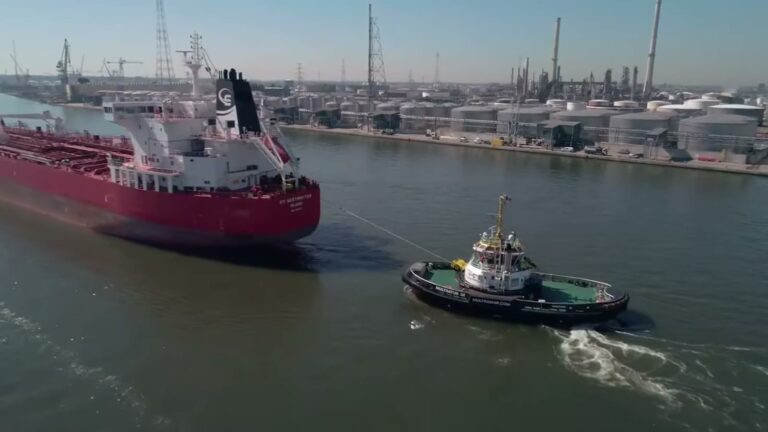
International Maritime Organization guidance recognises tug assistance as part of the ship-port interface. [S4] That does not translate into a universal number of tugs or a universal bollard-pull threshold. Those decisions depend on local geometry, the ship, traffic, weather, pilotage practice and the manoeuvre being performed.
It does mean that towage should be evaluated as part of the port’s control architecture. A review of a new vessel class should include questions such as:
- What control and stopping margin is needed at the critical points of the approach and berth?
- Which wind, current and visibility limits remain acceptable?
- What happens if propulsion or steering is lost at the least forgiving location?
- Is the available tug capability assessed in the conditions in which it will actually be used, rather than only at a static bollard?
- Can pilots, tug masters and terminal teams operate to a shared, tested plan?
These are operating-envelope questions. They cannot be answered by channel depth alone.
Novatug’s view: control is floating infrastructure
The independent sources above establish the cascading mechanism and the fact that bigger vessels place pressure on multiple port systems. They do not endorse a particular tug design.
Novatug’s position is that a port can add useful capability through advanced towage as well as through fixed civil works. The Carrousel Rave Tug is designed to provide enhanced control over large vessels and to eliminate the mechanical cause of girding through its freely rotating towing point. Novatug describes this role as floating infrastructure and an infrastructure lifespan extender. [S5]
This is a strategic proposition. Port-specific engineering and operating analysis still decide what is safe. The additional question is what control capacity would allow the existing port to handle the vessel more safely while fixed works are considered.
Review the operating envelope before the call changes
The cascade is already part of container shipping economics. Ports that identify the next vessel class before it becomes a standard call have time to test the control system around it.
Harbour masters, pilots, terminal operators and towage providers should be part of that assessment. A deeper channel may be necessary. It rarely answers the whole problem.
Questions port planners should answer
What is vessel cascading?
Vessel cascading is the redeployment of ships displaced by newer, larger vessels on major trade lanes. The displaced ships move to secondary routes and may displace smaller ships again. [S1]
Does vessel cascading mean every port will receive mega-ships?
No. Deployment depends on trade volumes, infrastructure, commercial decisions and operating constraints. The point is that vessel-size pressure can spread beyond the original hub routes, so ports should regularly reassess the vessel envelope they are prepared to handle. [S1]
Is dredging enough to prepare for a larger vessel class?
Not necessarily. Dredging addresses under-keel clearance, while larger ships can also affect manoeuvring, air draught, berthing, terminal operations and towage requirements. [S1][S3]
What should a port assess before accepting larger container vessels?
Review the whole operating envelope: channel geometry, weather and tidal limits, pilotage, traffic, berth arrangements, communications, emergency scenarios and towage capability. The precise assessment must be specific to the port and vessel. [S3][S4]
Sources
- [S1] International Transport Forum at the OECD, The Impact of Mega-Ships, 2015.
- [S2] UN Trade and Development, Review of Maritime Transport 2024: Navigating Maritime Chokepoints, 2024.
- [S3] PIANC MarCom Working Group 121, Harbour Approach Channels: Design Guidelines, 2014.
- [S4] International Maritime Organization, MSC.1/Circ.1101/Rev.3: Ship/Port Interface, Availability of Tug Assistance, 2021.
- [S5] Novatug, Carrousel Rave Tug.
- [S6] Journal of Commerce, Cascading container tonnage spreads structural overcapacity to secondary lanes, 2025.
- [S7] Lloyd’s Register, Feeder fleet up for an overhaul, 2025.
- [S8] Sea-Intelligence, Sunday Spotlight 744, 2025.
Related reading
- Why Dredging Alone Does Not Solve the Mega-Ship Problem
- Towage Belongs in the Port Safety Case
- Static vs Dynamic Bollard Pull: What Escort Towage Needs to Show
- Explore the Carrousel Rave Tug
If your port is reviewing a new vessel class, contact Novatug for a port-specific discussion of vessel envelope, operating limits and towage control requirements.