Summary
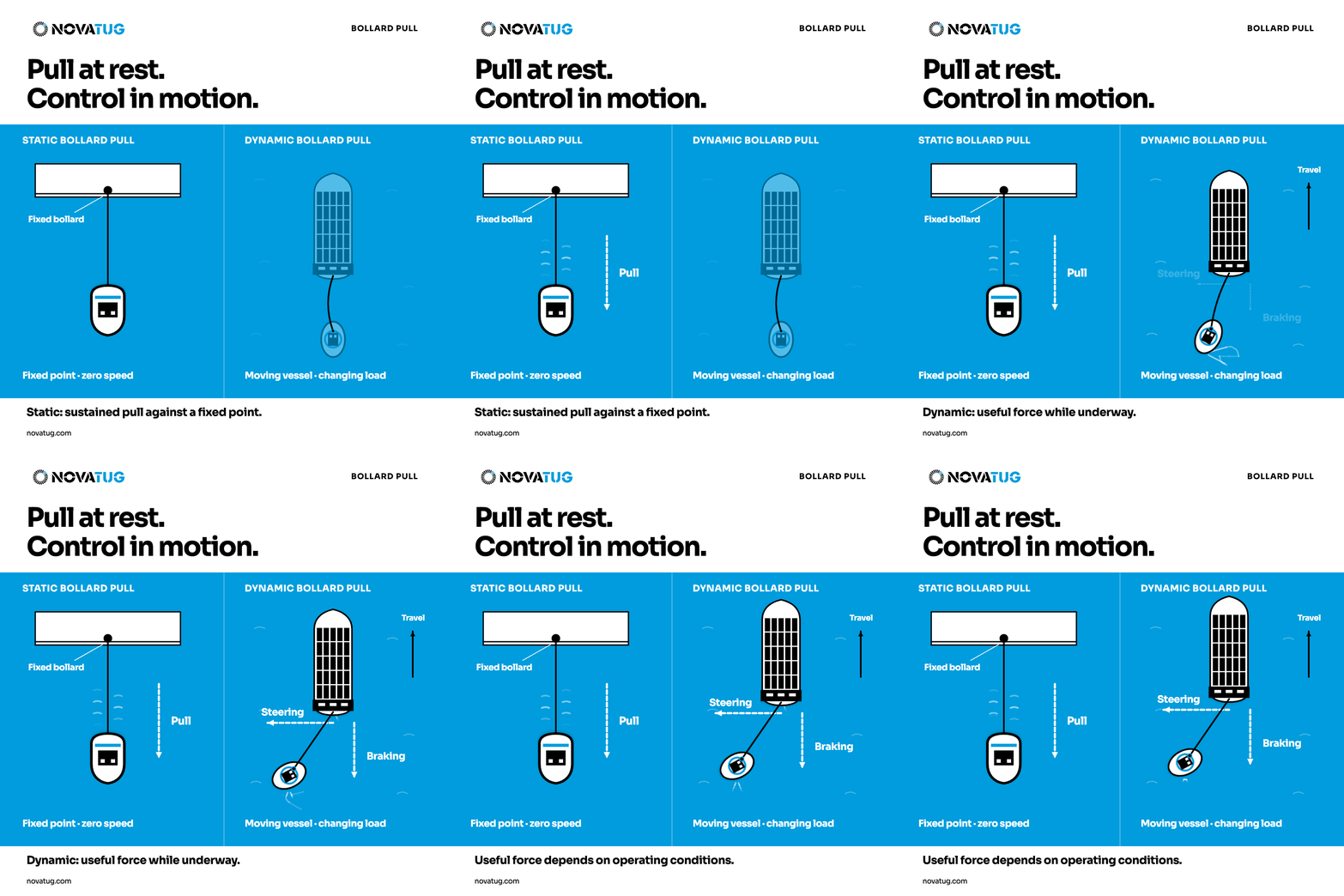
Static bollard pull remains one of the most useful and widely recognised tug-performance figures. It records a sustained pull while the tug is effectively stationary, creating a clear and repeatable baseline for certification and comparison. ABS guidance, for example, defines static bollard pull as the average load-cell result over a sustained five-minute pull at maximum continuous rating, with short spikes excluded. [S1]
That is not, however, the same question as escort performance. When a tug is connected to a moving ship, the operational need may be to steer, brake or stabilise the ship at a particular speed and towline angle. Those forces depend on the tug, the assisted vessel, the line arrangement, water depth and environmental conditions.
The practical conclusion is simple: retain static bollard pull as a certified baseline, but complement it with transparent escort-performance data for the operating conditions that matter.
Key takeaways
- Static bollard pull establishes a sustained, zero-speed pulling reference. [S1]
- The IMO stability code also uses a documented maximum continuous pull from a static bollard-pull test as the bollard-pull value for its towing and escort stability provisions. [S2]
- Escort capability is a distinct, speed-dependent performance question. DNV’s escort-tug rules provide for escort rating numbers established through full-scale testing or numerical methods. [S3]
- A port or operator should evaluate tug capability against the actual vessel, passage, speed, towline arrangement and consequence of loss of control, rather than rely on one headline number alone.
Static pull, dynamic line force and escort rating are not interchangeable
These terms describe related but different things:
| Measure | What it describes | Essential context |
|---|---|---|
| Static bollard pull | Sustained pull against a fixed point at effectively zero speed | Test procedure, engine rating, duration and environmental limits |
| Dynamic line force | Towline force developed while the tug and assisted vessel are moving | Speed, tug heading, towline angle, water depth, vessel configuration and whether the value was measured or simulated |
| Escort steering or braking force | The useful component of tug force acting to turn or slow the assisted vessel | Assisted-vessel speed, direction of force, connection point and escort-test or calculation method |
A value from one regime should not be converted into another without the conditions and method. In particular, dividing a maximum dynamic line-force result by a static bollard-pull certificate does not establish a general performance multiplier against other tugs.
What static bollard pull measures well
In a static bollard-pull test, a tug applies a sustained pull to a fixed point. The result provides a disciplined reference for the propulsion system, towing equipment and ship’s continuous output under defined trial conditions.
This is valuable information. It supports tug comparison, equipment design and stability calculations. The IMO’s intact-stability code explicitly describes bollard pull for towing and escort operations as the documented maximum continuous pull from a static test. [S2]
The mistake is not using static bollard pull. The mistake is treating it as a complete description of every towing task.
Escorting asks a different question
During escort towage, the assisted ship is moving. The tug’s useful contribution can include a component of steering force, braking force or both. The direction and magnitude depend on speed, towline geometry, tug heading, hull form, available water and the limits of the towing arrangement.
That is why classification rules distinguish escort capability from a conventional bollard-pull notation. DNV’s escort-tug rules allow escort rating numbers to be established through full-scale tests or numerical methods. [S3] The rating is intended to describe a particular operating condition, not a universal force available in every direction.
This distinction matters most where recovery distance is limited: a bridge approach, a narrow channel, a lock entrance or a berth with large vessels nearby. In those places, the relevant question is not only “how much can the tug pull while stopped?” but also “what controlled force can it apply now, at this speed and in this direction?”
Reading an escort-force diagram
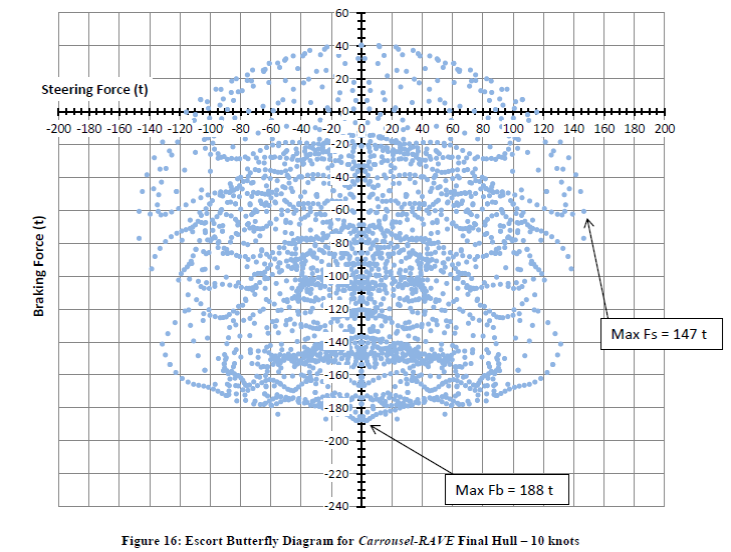
The featured diagram is a Novatug CRT escort-force simulation at 10 knots. It maps combinations of simulated steering and braking force for a defined hull, speed and modelling condition. The diagram reports a maximum steering force of 147 tonnes and a maximum braking force of 188 tonnes. [S4]
It should not be read as a generic promise of performance. It is an illustrative condition-specific result, not a substitute for an operational assessment, full-scale trial or local escort study. Its value is in showing the type of information that a static figure cannot communicate on its own: force direction, speed and the trade-off between steering and braking.
A more useful performance picture
For escort work, a performance description should make the operating conditions visible. At minimum, it should state:
- the assisted-vessel class and displacement range;
- the speed range and waterway assumptions;
- the towline connection and geometry;
- the available steering and braking force, including direction; and
- whether the result comes from full-scale testing, validated simulation or calculation.
This does not mean replacing a simple, established test with an opaque new number. It means adding the information decision-makers need when they are selecting towage for a moving large vessel.
Static bollard pull would remain the common reference. Condition-specific escort data would show how a tug can use that capability in the manoeuvre for which it is being chosen.
From headline figure to operational decision
No single figure can determine whether a tug arrangement is suitable for a critical passage. The vessel, speed, waterway, weather limits, traffic, tug position and time available to intervene all matter.
For ports, pilots and operators, the next step is therefore practical: identify where a loss of propulsion or steering would become unacceptable, then test whether the available tug arrangement can deliver meaningful control at that point. That assessment may include speed limits, connected escort towage, operating windows, abort points and infrastructure protection as complementary safeguards.
Novatug’s position is that dynamic bollard pull and speed-dependent escort performance deserve clearer, comparable treatment. The aim is not to discard static bollard pull. It is to make tug capability more visible where it matters most: in motion.
How to interpret the Multratug 32 figures
Novatug reports a static bollard pull of 70 tonnes for Multratug 32 and a maximum dynamic line-force result of up to 180 tonnes. [S5] Those figures should be presented as two different performance measures, not as proof that the CRT produces a universal multiple of the force of a conventional tug.
Related reading
- Simulation Study: Could a Connected CRT Have Helped Prevent the Dali Collision?
- Near Critical Infrastructure, a Tug Nearby Is Not Enough
- How Escort Tugs Control Large Vessels at Speed
- Explore the Carrousel Rave Tug
If you are evaluating a critical passage or escort-towage arrangement, contact Novatug to discuss the control requirements.
Sources
- [S1] American Bureau of Shipping, Rules for Building and Classing Marine Vessels, Part 5D, Chapter 3, Appendix 1: Guidelines for Static Bollard Pull Test Procedure, 2024.
- [S2] International Maritime Organization, Resolution MSC.415(97): Amendments to Part B of the International Code on Intact Stability, 2008, 2016.
- [S3] DNV, DNV GL Rules for Classification: Ships, July 2017, 2017.
- [S4] Novatug, Escort Butterfly Diagram for Carrousel-RAVE Final Hull, 10 knots, internal simulation figure, 20 October 2016.
- [S5] Novatug, Carrousel Rave Tug technical page, current technical specification page.