Channel depth and berth length are the usual measures of port capacity. They matter, but they do not answer a more practical question: can the port control the largest vessels that use it?
A port’s fixed capacity sits in its channels, berths, cranes, storage yards and road and rail links. Its usable capacity also depends on what happens while a large vessel is moving: entering, turning, slowing, berthing and leaving in wind, current and traffic.
That control margin is easy to overlook because it is not measured in metres or tonnes of cargo. It is nevertheless part of the port’s ability to handle a vessel safely.
Depth and control are different constraints
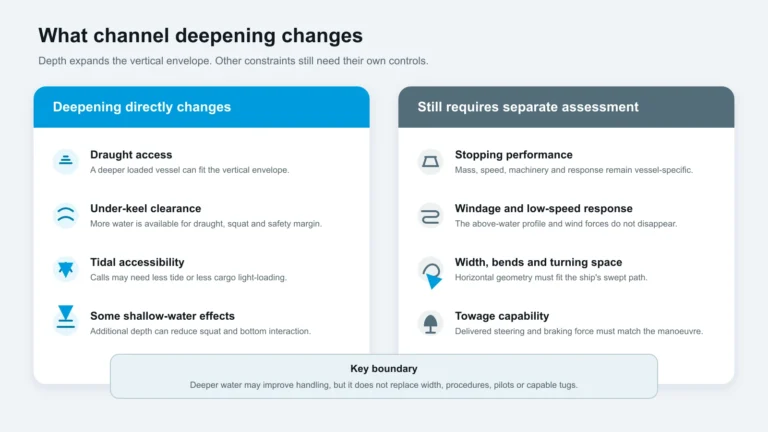
Dredging can deepen a channel. It cannot make a vessel shorter, reduce its windage or give it more stopping force.
PIANC’s harbour approach-channel guidance treats channel design as more than a depth calculation. It considers vessel dimensions and manoeuvrability, wind effects, human factors, risk, manoeuvring areas and operational restrictions. PIANC Harbour Approach Channels Design Guidelines
A deeper channel may remove an under-keel-clearance constraint. It does not provide the force needed to arrest a vessel’s momentum or recover its heading. Those are separate engineering and operating questions.
That gap between access and control is where theoretical capacity becomes practical capacity.
Control is shared across the port
During a large-vessel movement, control is shared by the ship’s machinery and bridge team, the pilot, Vessel Traffic Services, harbour control and the towage team. The channel and the available recovery space set the limits within which they have to work.
The International Maritime Organization describes Vessel Traffic Services as shore-side systems that contribute to safe and efficient navigation, especially in areas with dense traffic, narrow channels or navigational difficulty. IMO Vessel Traffic Services
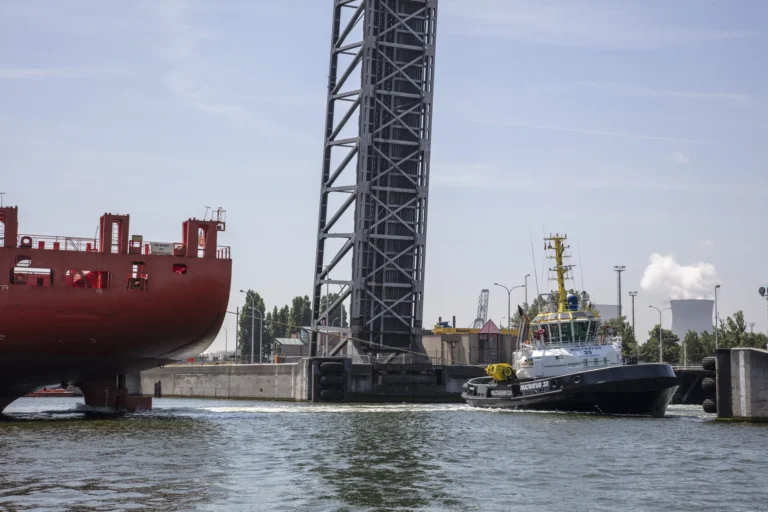
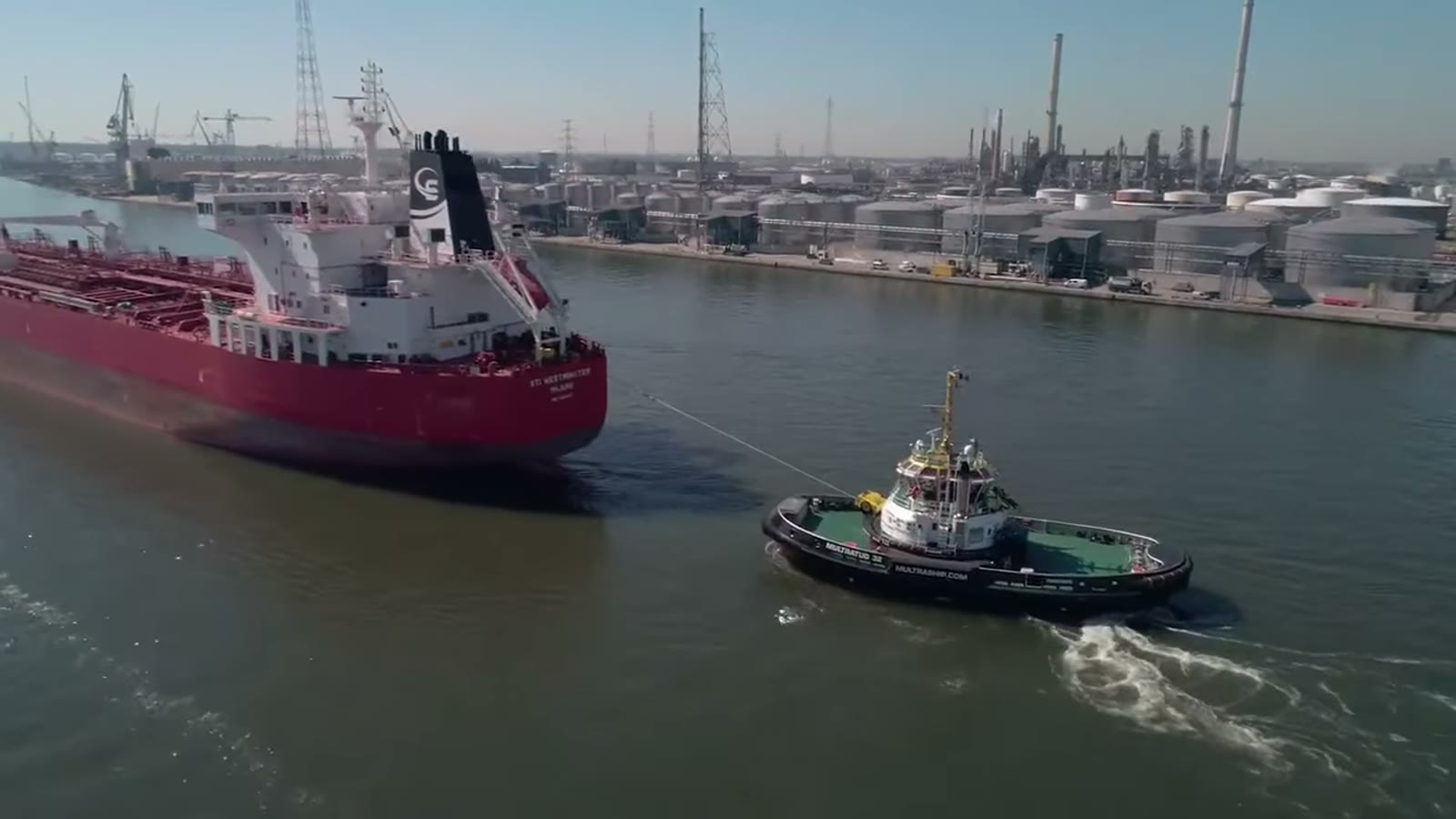
Tugs provide another physical control layer. The Port of Rotterdam lists berthing, unberthing, manoeuvring and the movement of large vessels among the purposes of towage. Port of Rotterdam nautical services
A tug is part of the port’s control system. It may be ordered for the final metres before the berth, but its value also lies in the control it can provide during the approach.
Vessel growth changes the operating envelope
Ports are facing long-term vessel growth alongside sudden changes in shipping patterns. UN Trade and Development has reported longer routes, pressure on maritime chokepoints and rising risks of disruption and delay to port and shipping infrastructure. Rerouting around the Red Sea and Panama Canal also contributed to congestion and additional vessel demand in 2024. UNCTAD Review of Maritime Transport 2024
The fixed works that respond to those pressures move slowly. Vessel deployment can change in a season.
When larger ships enter the main trade lanes, the ships they replace often move to secondary routes. Smaller ships are then displaced again. A regional port can inherit a larger vessel class without having changed its channel, tug fleet or emergency procedures.
The channel may be deep enough and the berth long enough. The control margin can still be too small.
Recovery time belongs in capacity planning
The 2024 contact between the Dali and the Francis Scott Key Bridge shows why time and distance belong in the assessment.
The National Transportation Safety Board found that the Dali lost electrical power, propulsion and steering while transiting Baltimore Harbor. Its proximity to the bridge left little time to recover propulsion before the contact. NTSB final investigation
The investigation does not establish that another towage arrangement would have prevented the casualty. It does establish the importance of asking what assistance can act within the available distance after a major loss of control.
For a port, recovery time is part of capacity. A vessel that can be managed in open water may need a different control arrangement near a bridge, lock, turning basin or terminal.
Start with a port-control review
Before accepting a new vessel class, a port should review the complete operating envelope. The review should:
- Compare the vessel’s mass, dimensions, windage and momentum with the channel and berth.
- Map the points where a loss of propulsion or steering would leave too little room for recovery.
- Assess tug capability in motion, including dynamic bollard pull, braking, steering and towline geometry.
- Test the effect of wind, current, waves, traffic and hydrodynamic interaction.
- Define the communication, abort and emergency-response decisions before the call begins.
- Check whether backup tug availability is sufficient for the consequence of a failed intervention.
This review produces a more useful answer than a single draft figure or static bollard-pull number. It shows where the port has room, where it has time and where it needs more control.
Towage as floating infrastructure
Novatug’s position is that towage can add control capacity alongside fixed civil works.
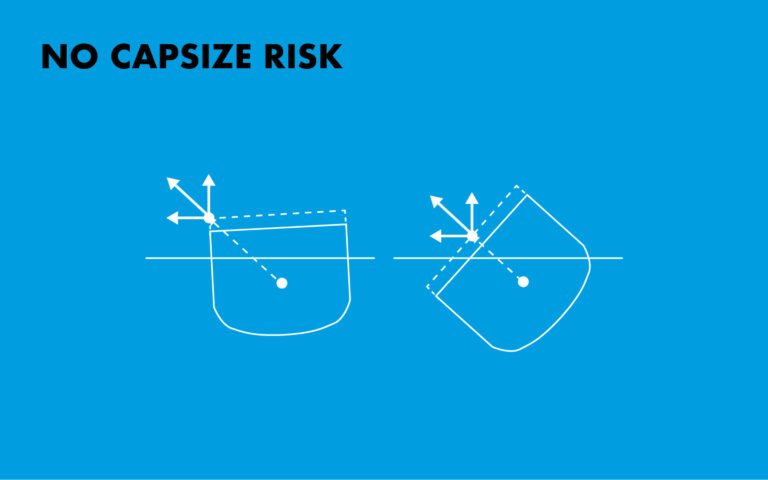
The Carrousel Rave Tug is designed to control large vessels while they are moving. Its Carrousel Towing System lets the towing point rotate freely around the tug’s superstructure. The design eliminates the mechanical cause of girding under transverse towline load, so the CRT cannot capsize under that load. Its slender hull also uses hydrodynamic forces to contribute to braking and steering.
These are design and positioning claims from Novatug, not conclusions from the Dali investigation. The infrastructure argument is narrower: if a port needs more control, a mobile asset can address a different constraint from dredging.
Towage complements dredging and expansion. Depth, width, berth geometry, traffic management and control capability still have to work together. A deeper channel cannot solve a control problem that it was never designed to address.
Plan for the vessel the port will actually receive
Ports do not choose their vessel mix in isolation. Trade routes, fleet deployment and disruptions can change which ships arrive and how often they call.
Infrastructure planning should include control capacity from the start. The port needs enough time, space, towage capability and coordination to keep the vessel under control within the channel.
The next step is to measure that control margin. Contact Novatug about port assessments and simulations.