The margin can be measured in seconds
Large vessels regularly pass close to bridges, locks, terminals, subsea assets and dense waterfronts. In those places, the margin after a blackout or steering failure may be measured in seconds.
The Dali casualty demonstrated that reality in the hardest possible way. The NTSB found that the containership lost electrical power, propulsion and steering close to Baltimore’s Francis Scott Key Bridge. [S1]
Every port should test whether a large vessel needs connected escort capability near its most consequential infrastructure. A tethered tug will not be necessary for every passage. The decision should be made before an emergency, using the vessel, waterway and recovery distance that actually apply.
What the case shows
- A tug that is nearby may still be too far away to influence a ship after a sudden blackout.
- Dali’s two assist tugs had been released before the emergency. When one was called back, Dali was 474 metres from the bridge and the tug was about 5 km away. [S2]
- The NTSB did not conclude that connected escort towage would have prevented the collision. That answer depends on local geometry, ship speed, tug capability and operating conditions. [S1][S2]
- UK port-safety guidance requires towage procedures to be risk assessed, reviewed and designed to include emergency response. [S3][S4]
- Novatug’s Dali simulation provides a relevant test case, not a universal prescription: a CRT already connected to the stern safely steered and slowed a modelled vessel after a blackout. [S5]
A tug nearby is not the same as a tug connected
The difference is time.
On Dali’s departure from Baltimore, two ship-assist tugs were used for undocking. The aft tug was released at 0106:57. The forward tug’s line was recovered at 0108:47. [S2]
The first loss of power began at 0124:59. When the pilots called the tugboats at 0126:38, Dali was travelling at 8 knots, turning to starboard and about 474 metres from the Key Bridge. The Eric McAllister was about 5,095 metres away. Its captain turned immediately and headed back at 12 knots. [S2]
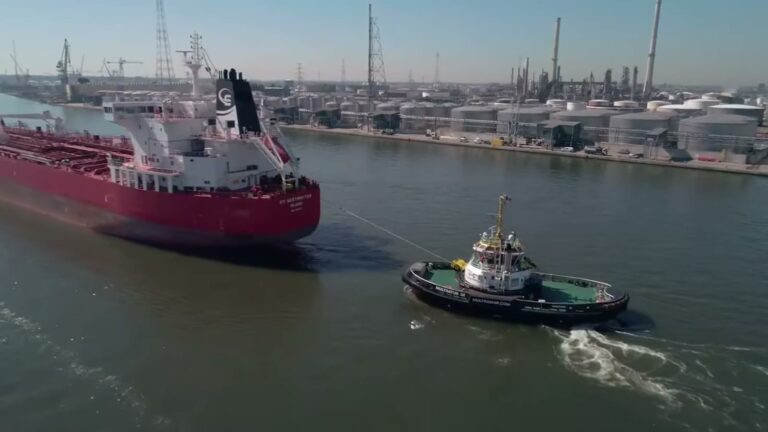
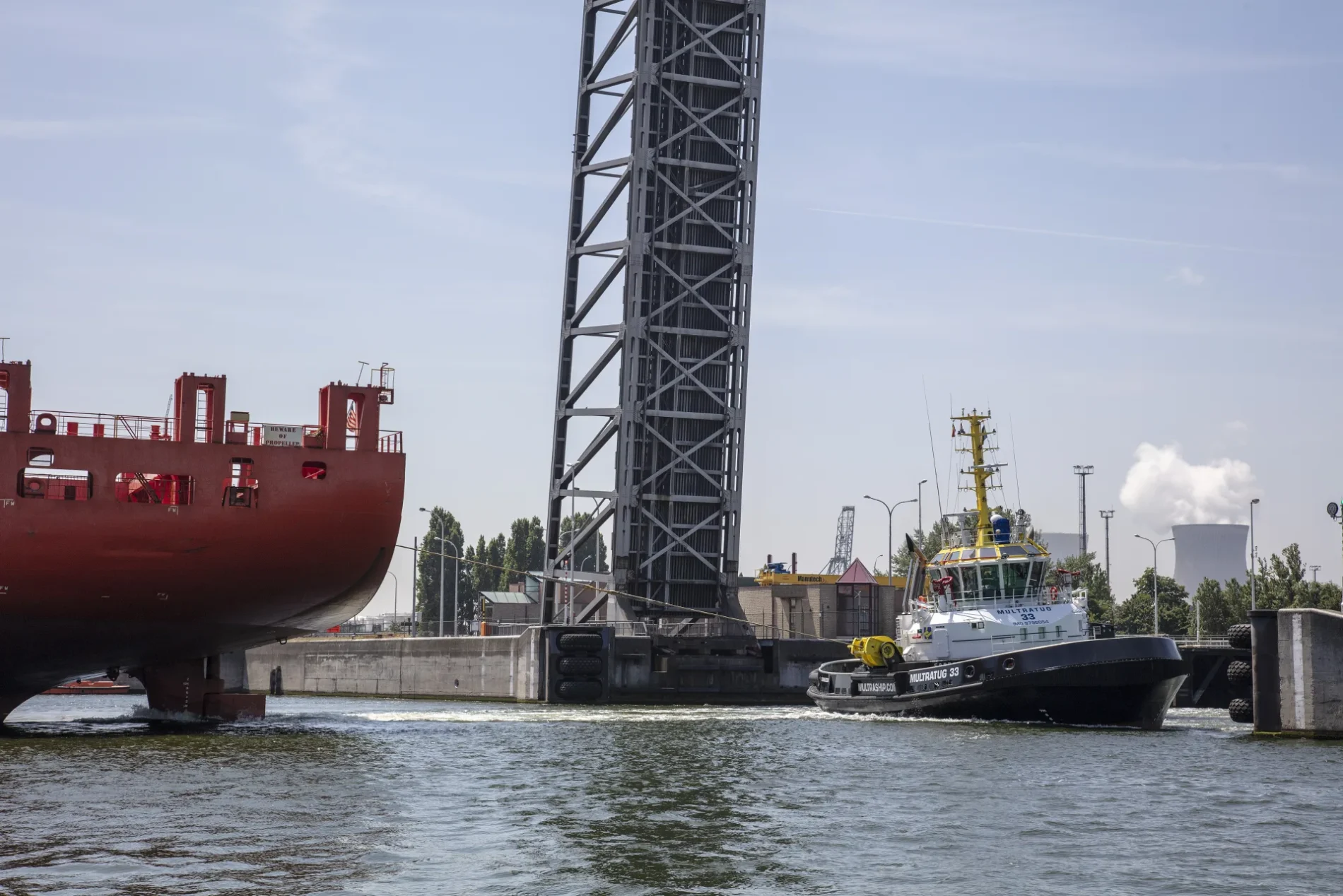
This describes a physical limit, not a criticism of the people involved. A tug which has to turn around, cover kilometres of water, come alongside and make fast has no opportunity to apply force in the first moments of a blackout. A tug already connected does.
In a low-consequence reach of water, that difference may be acceptable. Near a bridge pier, a lock gate, a congested terminal or a narrow turn, it may not be.
Control at the point of failure
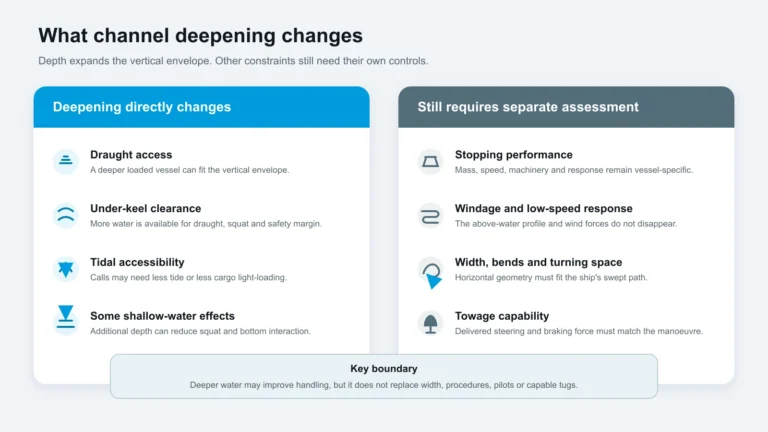
Connected escort towage should not become a fixed tug count for every large vessel. The arrangement has to fit the passage.
The test is whether the ship can still be influenced after propulsion or steering is lost at the point where control matters most. Vessel mass and speed, waterway geometry, wind and current, distance to the hazard, line geometry and tug capability all set the answer.
A tug matrix on its own cannot answer that. It may specify how many tugs are needed to berth and unberth a vessel. It does not say what happens after those tugs have been released, while the vessel is still within the consequences of a failure.
The UK Ports and Marine Facilities Safety Code says that towage procedures should be developed, managed and regularly reviewed by ports, tug operators, pilots and vessel owners, and should include emergency response. The accompanying guidance says harbour authorities should risk assess towing operations and develop specific towage guidelines with stakeholders. [S3][S4]
The principle applies beyond the UK. The arrangement has to be local, tested and reviewed.
What Dali does and does not show
The NTSB’s final finding was clear: a loose signal-wire connection caused the blackout that resulted in loss of propulsion and steering close to the bridge. The investigation also identified the bridge’s vulnerability to an ocean-going vessel strike as a contributor to the collapse and loss of life. [S1]
No single operational decision explains the tragedy. Escort tugs do not replace bridge protection, machinery reliability, pilotage, communication or emergency response. Ports need those layers to work together.
A safety layer must also be able to intervene before the available distance has gone.
For every critical transit, a port should be able to answer five questions before the ship approaches:
- What failure are we designing for: blackout, steering loss, main-engine failure, anchor failure, tug delay or a combination?
- At what location does the remaining distance become too short for recovery?
- What force is needed at that point, in which direction and at what ship speed?
- Must a tug be connected to provide that force, or can an immediately available alternative meet the need?
- What is the abort decision if the control arrangement is not in place?
These questions turn escort towage into a local risk assessment.
A connected escort must also be safe for the tug
Keeping a tug connected is not a trivial precaution. A poorly designed escort arrangement can create serious hazards for the tug and its crew. Towline angle, speed, loading, tug stability, communication and emergency release all matter.
The answer is not to keep any tug attached for longer. The port must assess the operation, select a suitable tug and towing arrangement, set safe limits and rehearse the emergency plan.
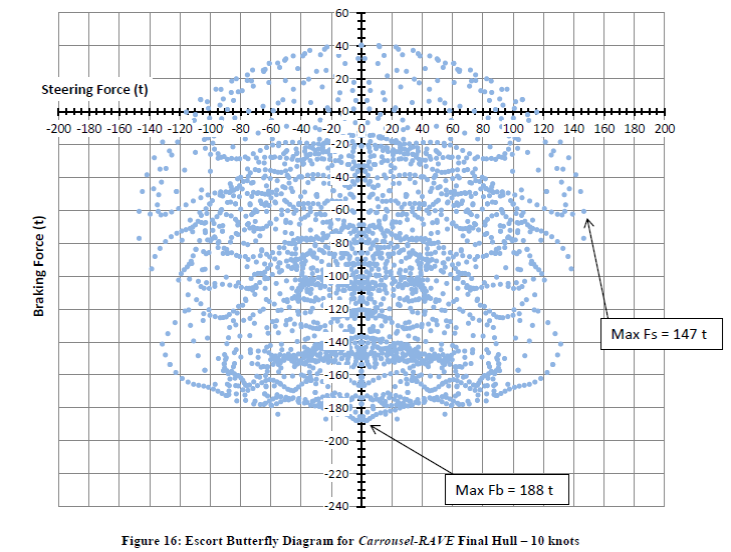
Novatug’s Carrousel Rave Tug was developed around this challenge. Its towing point is mounted on a rotating ring, so the point of tow follows the towline rather than forcing the tug into a fixed transverse loading geometry. Novatug’s structural claim is that this removes the mechanical cause of girding. The CRT is also designed to use hydrodynamic force from its hull to steer and brake a moving assisted ship.
Those design claims are not findings of the Dali investigation. They address the engineering problem a connected escort arrangement must solve: applying useful force at speed without exposing the tug crew to unsafe towing geometry.
What the simulation tested
Novatug’s simulator study is not an exact reconstruction of the Dali casualty. It used a larger, heavier virtual containership and a more restrictive bridge approach. It modelled one CRT connected on the stern before a total propulsion loss at 8.7 knots. After an 85-second delay, the tug applied steering and braking force. The modelled vessel passed safely and slowed to 3 knots. [S5]
The result does not prove that a CRT would have prevented the Dali collision. It gives ports a defined scenario to test. The operating problem changes when the tug is already in the force path, briefed and able to act.
Read the full Dali CRT simulation study and watch the eight-minute simulator recording.
Make escort capability part of the safety case
Connected escort towage should be treated as one potential safety barrier, not as a marketing slogan or a universal mandate.
For ports with critical infrastructure nearby, the decision should be made through a joint review involving the harbour authority, pilots, towage operator and ship interests. It should test the actual vessel classes, operating speeds, available tugs, line arrangements, weather thresholds, communication plan and abort points. Simulator exercises can make those choices visible before a real emergency makes them irreversible.
The Dali casualty showed how little time can remain after a large ship loses control. The question is no longer whether a tug can help in principle. It is whether the tug can help before the point of no return.
Further reading
The following sources take different positions on escort towage and help place the Dali discussion in context:
- Pilot Viewpoint: Bridging the Gap Between Port Risk and Towage Safety, by Riviera Maritime Media, argues that critical choke points should be assessed before an incident occurs. [S9]
- A Remedy for Ship Accidents: Tug Escorts, by The Maritime Executive, argues for escort towage in identified consequence zones. [S6]
- Tug Escort Rules in Ports May Be Reviewed After the Key Bridge Collapse, by WorkBoat, argues against a uniform requirement and in favour of local risk assessment. [S7]
- Ship Escort Is More Than Just Bollard Pull, by Riviera Maritime Media, focuses on crew training, tug capability, towing geometry and the escort plan. [S8]
The practical decision is local: can the arrangement prevent a loss of control from becoming damage to critical infrastructure?
Sources
- [S1] US National Transportation Safety Board, Contact of Containership Dali with the Francis Scott Key Bridge and Subsequent Bridge Collapse, 2025.
- [S2] US National Transportation Safety Board, Nautical Operations Factual Report, 2025.
- [S3] UK Department for Transport and Maritime and Coastguard Agency, A Guide to Good Practice on Port and Marine Facilities, updated 15 April 2025.
- [S4] UK Department for Transport and Maritime and Coastguard Agency, Ports and Marine Facilities Safety Code, updated 15 April 2025.
- [S5] Novatug, Simulation Study: Dali Collision – Comparison Study to Investigate Effectiveness of CRT Type Tugboat, 30 May 2024.
- [S6] Tony Munoz, A Remedy for Ship Accidents: Tug Escorts, The Maritime Executive, 30 March 2024.
- [S7] Pamela Glass, Tug Escort Rules in Ports May Be Reviewed After the Key Bridge Collapse, WorkBoat, 3 April 2024.
- [S8] Martyn Wingrove, Ship Escort Is More Than Just Bollard Pull, Riviera Maritime Media, 21 July 2026.
- [S9] Martyn Wingrove, Pilot Viewpoint: Bridging the Gap Between Port Risk and Towage Safety, Riviera Maritime Media, 6 July 2026.
If you are reviewing escort requirements near critical infrastructure, contact Novatug to discuss a scenario-led assessment.