What the study tested
On 26 March 2024, the containership Dali lost electrical power, propulsion and steering while outbound from Baltimore Harbor and struck a pier of the Francis Scott Key Bridge. Six road workers died when the bridge collapsed. The NTSB concluded that a blackout caused by a loose signal-wire connection led to the loss of propulsion and steering close to the bridge. [S2]
Novatug asked a narrower operational question: if a Carrousel Rave Tug (CRT) had remained connected to the stern, could it have applied enough steering and braking force to influence the ship’s course after propulsion failure?
The resulting simulator study does not recreate the Dali casualty exactly. It uses a different, larger virtual containership and a more restrictive bridge approach. Within that scenario, however, one connected CRT safely guided the vessel through the passage after total propulsion loss, reducing speed from 8.7 knots to 3 knots. [S1]
The study does not establish that the Dali collision would have been prevented. It gives ports a defined case for testing connected escort towage where a large vessel passes close to infrastructure with little room for recovery.
The result in brief
- The NTSB found that Dali lost propulsion and steering close to the Key Bridge, leaving very little time to recover control. [S2]
- Novatug’s study started with one CRT already connected to the stern of a simulated containership. [S1]
- The modelled vessel was larger and heavier than Dali, and the bridge passage was more restrictive than the Baltimore opening. [S1]
- After an 85-second delay following the blackout, the CRT applied steering and braking force. The simulated vessel passed safely at 3 knots, with a reported peak towline force of 78.6 tonnes. [S1]
- The study supports a practical question for ports: at the critical point of a passage, is a suitable tug already connected and able to act?
The problem was time, not awareness
The Dali casualty was not a routine navigation error. The NTSB found that an electrical blackout caused the ship’s loss of propulsion and steering close to the bridge. [S2]
Two ship-assist tugs had helped the vessel leave berth. The final NTSB factual report records that the aft tug was released at 0106:57, and the forward tug recovered its line at 0108:47. The first loss of power began at 0124:59. When the pilots called the tugboats for assistance at 0126:38, Dali was about 474 metres from the bridge; the Eric McAllister was about 5,095 metres away and turned back immediately. [S3]
The sequence matters without assigning blame. The tugboats responded after being called. A tug that must turn, run back, approach and make fast cannot deliver control in the first seconds of a blackout. A tug that is already connected can.
What the study simulated
The simulation used a FORCE maritime simulator certified to DNV standards and was performed by a licensed tug captain with more than 20 years’ tug-master experience and more than five years as a senior training captain. [S1]
Because the simulator database did not contain an exact Baltimore model or an exact Dali model, the study used conservative alternatives:
- a virtual containership 349.3 metres long, 51 metres wide and 155,800 tonnes displacement, compared with Dali’s reported 299.92 metres length, 48.2 metres beam and 112,383 tonnes departure displacement; [S1]
- the Botlek bridge approach in Rotterdam, rather than Baltimore, with a tighter bridge passage; and
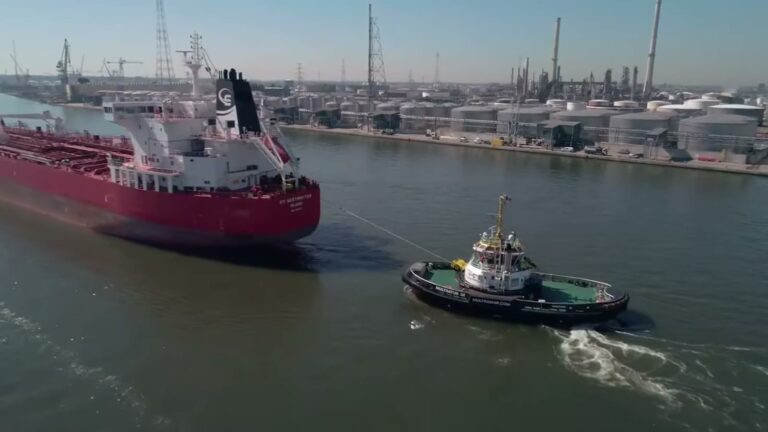
- one CRT, represented by the 31.9-metre Multratug 32, connected on the stern before the failure. [S1]
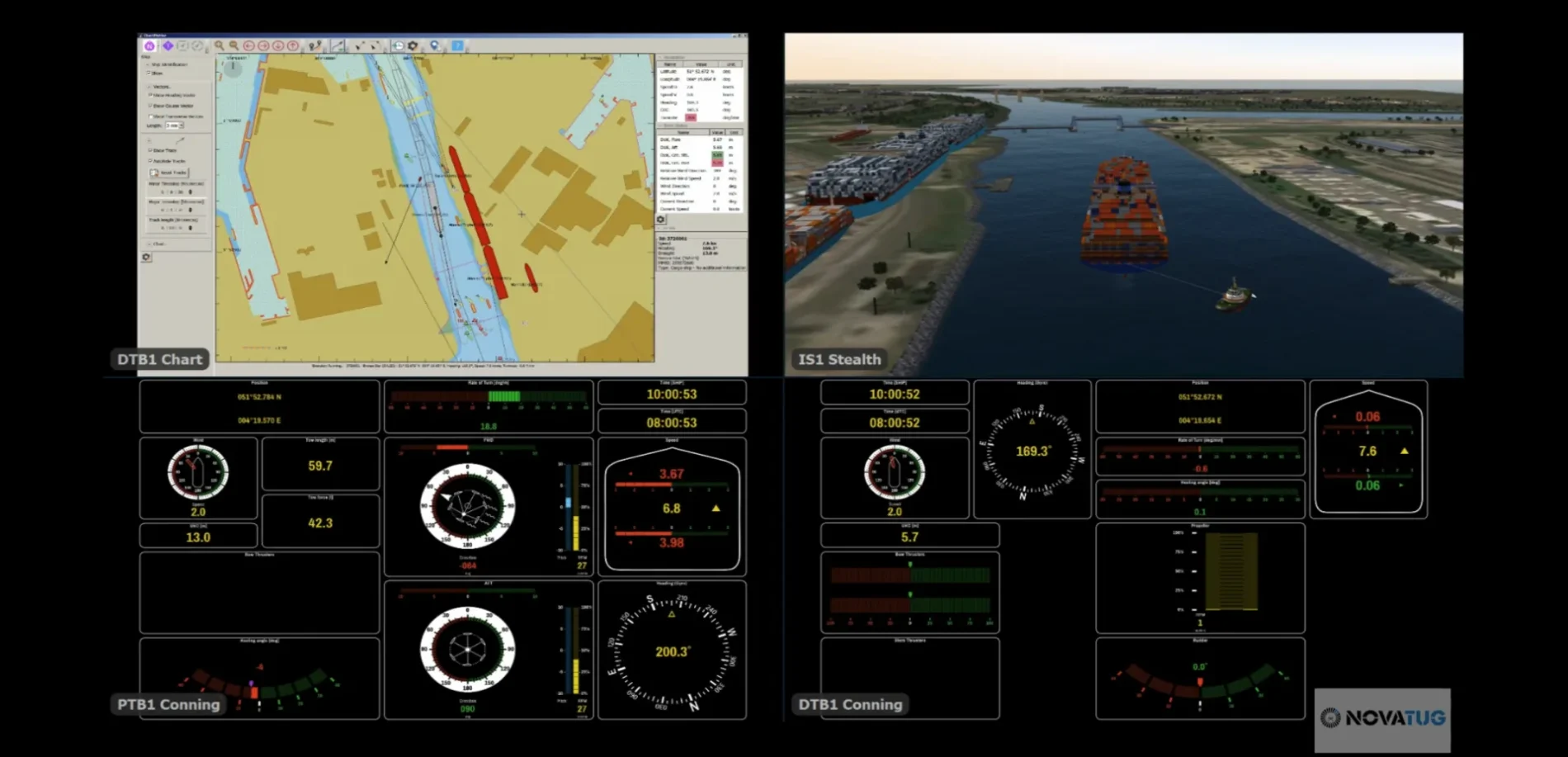
The modelled vessel was travelling at 8.7 knots when its propulsion was set to zero. Its rudder was initially put hard to starboard to create a loss-of-course condition, then returned amidships. The CRT did not start acting immediately. The scenario built in an 85-second interval between blackout and tug response to represent delay in communication. [S1]
What happened in the simulation
After the delay, the CRT changed its heading to create towline angle and force. The study reports that it used the tug’s hull resistance to apply steering and braking force while the containership was still moving. [S1]
The simulated ship passed safely through the Botlek bridge approach. Its speed fell to 3 knots. The highest reported towline force was 78.6 metric tonnes. The study also reports that the tug’s engine-power demand was limited to 300 horsepower per engine, or 600 horsepower in total, during the assistance. [S1]
The full run is available below. It shows the sequence rather than only the final result: blackout, delay, change of tug angle, force generation, course correction and speed reduction.
Watch the complete simulator recording: YouTube [S4]
Why a CRT can contribute at speed
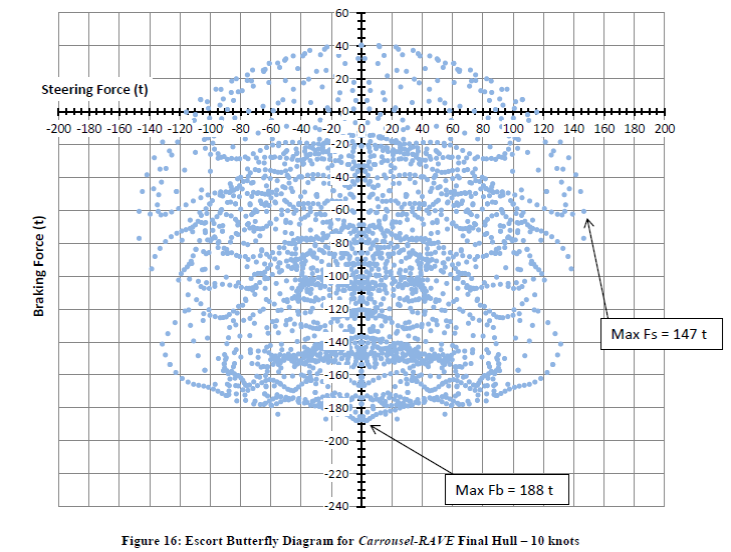
Most harbour tugs are selected and discussed using static bollard pull: the force measured when a tug is tied to a fixed bollard. That remains a useful reference, but the operating problem in this simulation is dynamic. The assisted ship is moving, and the needed force must be applied in a particular direction, through a safe towing geometry, before the available distance is gone.
The CRT is designed for that setting. Its towing winch sits on a steel ring that rotates around the tug’s superstructure, allowing the towing point to follow the towline. Its slender hull is intended to generate hydrodynamic steering and braking force while the assisted vessel is moving. These are Novatug design claims. The simulation tests how that concept behaved in one defined scenario. [S1]
What the study does and does not establish
The study establishes a result within its stated assumptions: a connected CRT safely influenced a simulated vessel that was larger and heavier than Dali, operating in a tighter passage, after a modelled propulsion failure. [S1]
It does not establish the exact outcome in Baltimore. It did not reproduce Dali’s precise hull, machinery failure, wind and current, bridge geometry, anchor response, pilot decisions, tug arrangement or timeline. The NTSB did not conclude that a connected escort tug would have prevented the bridge strike. [S2][S3]
That boundary matters. A simulation is useful here because it identifies a control option for testing in the real conditions of each critical passage.
A question every critical passage should answer
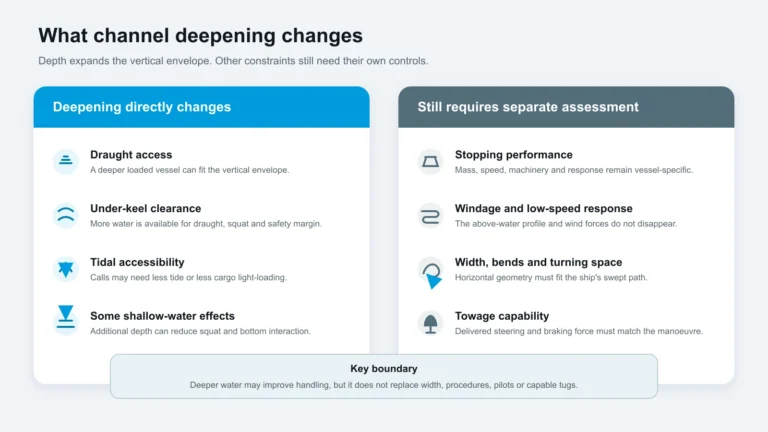
The Dali investigation showed how rapidly a propulsion failure can turn into an infrastructure emergency. For a port, the test is not simply how many tugs were used at the berth. It is whether a tug capable of applying meaningful force is already available at the point where a blackout becomes unacceptable.
For some passages, the answer may be a connected escort tug. For others, it may be speed restrictions, strengthened bridge protection, defined abort points, redundant propulsion measures or a combination of safeguards. The arrangement must be based on the local vessel, waterway, weather, tug capability and consequence of failure.
Novatug’s simulation gives that assessment a concrete starting point: one CRT, connected at the stern, changed the outcome of the modelled scenario.
Read and watch the study
- Download the full simulation report [S1]
- Watch the full simulator recording [S4]
- Explore the Carrousel Rave Tug
If you are reviewing a critical vessel passage or escort-towage scenario, contact Novatug to discuss the control requirements.
Sources
- [S1] Novatug, Simulation Study: Dali Collision – Comparison Study to Investigate Effectiveness of CRT Type Tugboat, 30 May 2024.
- [S2] US National Transportation Safety Board, Contact of Containership Dali with the Francis Scott Key Bridge and Subsequent Bridge Collapse, 2025.
- [S3] US National Transportation Safety Board, Nautical Operations Factual Report, 2025.
- [S4] Novatug, Dali Collision Simulation: CRT Tugboat Effectiveness, YouTube.