Cluster role: Primary cornerstone for Novatug research on vessel growth and the port-control gap.
Summary
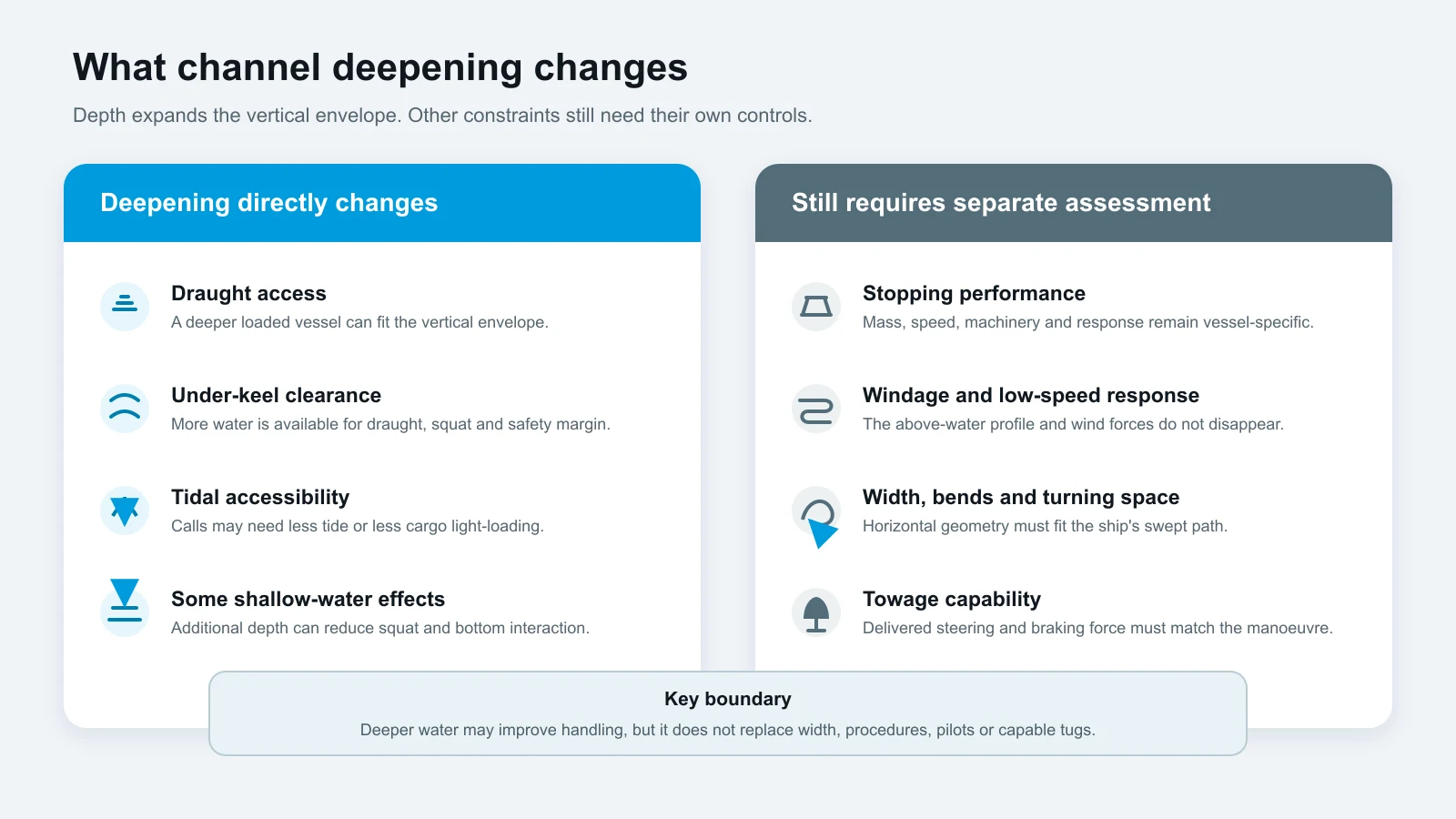
Ports dredge for good reasons. A deeper navigation channel can create safe under-keel clearance, accommodate greater vessel draught and reduce tidal restrictions or light-loading. In very shallow water, additional depth can also reduce some squat and handling penalties. [S1] [S2] [S3]
But “dredging” is often used too loosely. Major navigation projects may combine channel deepening with widening, bend wideners, turning-basin enlargement, berth work and operational controls. Those interventions solve different constraints. Depth addresses vertical access. Width and turning areas address horizontal geometry. Procedures, pilots and tugs address how the ship is controlled within that geometry.
The mega-ship problem is therefore both an access problem and a control problem. A port can have enough water beneath a ship while still facing long stopping performance, high wind forces, bank interaction, limited turning room and a towage capability that has not kept pace with the vessels now calling.
Key takeaways
- Dredging is necessary where a vessel cannot maintain safe under-keel clearance.
- Deeper water can improve access and reduce some shallow-water effects, but it does not change a ship’s length, beam, above-water wind area or inherent stopping data.
- Channel deepening, widening and turning-basin enlargement are different interventions and should not be treated as one thing.
- Vessel cascading brings larger ships to routes and ports that may have been planned around smaller design vessels.
- Tug capability must be assessed for the actual vessel, manoeuvre and conditions, not only by a nominal bollard-pull figure.
- Fixed infrastructure, procedures and floating control should be designed as complementary layers.
<figure class=”alignwide”> <a href=”visuals/01-what-dredging-changes.svg” aria-label=”Open Figure 1 full size”> <img src=”visuals/what-dredging-changes.webp” alt=”Comparison showing that channel deepening improves draught access and under-keel clearance while stopping, windage, turning space and towage capability still require separate assessment.” width=”1600″ height=”900″> </a> <figcaption>Figure 1. What channel deepening changes, and what still requires separate assessment. Deeper water can reduce some shallow-water effects, but it does not resolve every control or geometry constraint. [S1] [S2] [S3] [S4] [S5]</figcaption> </figure>
Why ports dredge
The direct purpose of channel deepening is vertical access. USACE guidance defines required channel depth as a combination of the design vessel’s loaded draught, squat, trim, wave action and safety clearance. AMSA’s under-keel-clearance system similarly accounts for tide, vessel speed, squat, tidal streams and dynamic vessel motions. [S2] [S3]
That access has economic value. Savannah’s expansion deepened its federal channel from 42 to 47 feet so larger, more heavily loaded ships could call with fewer tidal delays. Charleston’s Post 45 project deepened the inner harbor from 45 to 52 feet, enabling larger loaded vessels to call with less dependence on tide. [S9] [S10]
Depth is not optional when the physical water column is inadequate. No tug can change a ship’s draught or create safe clearance beneath its keel. The alternatives are a different loading condition, a tidal window, another route or physical works.
What deeper water changes
Deeper water does more than prevent grounding. USACE notes that vessels become harder to handle in shallow water and may require larger rudder angles. UK manoeuvring guidance requires ships to document shallow-water turning performance and squat across different depth-to-draught ratios and blockage factors. [S2] [S5]
It would therefore be wrong to claim that dredging has no control benefit. Increasing water depth can reduce squat risk and some bottom-related hydrodynamic penalties. The actual improvement depends on vessel speed, draught, channel cross-section and local conditions.
Dynamic under-keel-clearance management can also increase usable access without physically deepening every part of a route. It uses real-time or forecast information to manage the safety margin more precisely. But it does not make the seabed lower. It helps operators use the available water safely; it does not remove the ultimate depth limit. [S3]
What deeper water does not change
Deeper water does not shorten the ship. It does not narrow its beam, reduce its above-water profile or enlarge a turning basin.
IMO’s manoeuvrability standard allows a full-astern stopping track reach of up to 15 ship lengths, with an allowance up to 20 ship lengths for some large-displacement ships. That is a design criterion, not a prediction for a specific harbor approach, but it shows the scale of the stopping problem. A 400-metre ship measured at 15 ship lengths corresponds to 6 kilometres. [S4]
The ship’s manoeuvring booklet must separately describe stopping performance, shallow-water turning, wind forces, course-keeping under wind and low-speed control. These are distinct characteristics because depth alone does not determine them. [S5]
Channel width is also a separate design problem. USACE guidance says it depends on vessel size and manoeuvrability, traffic, wind, waves, currents, visibility, passing clearance and bank clearance. Bends require more width because a turning ship sweeps a wider path. Bank clearance also limits the effect of bank suction on controllability. [S2]
Mega-ships create a control problem as well as an access problem
UNCTAD data shows how quickly the vessel envelope has changed. Between the first quarter of 2006 and the fourth quarter of 2020, the largest deployed container ship increased from 9,380 TEU to 23,963 TEU. Across ports, the average size of the largest deployed ship rose 125%, from 1,996 to 4,482 TEU. [S7]
New ships are normally introduced on the largest east-west trades. Older large ships are then redeployed to other routes. UNCTAD describes this cascading of larger vessels to secondary routes and regional trades as an ongoing source of pressure for smaller ports. Larger vessels also create fewer but longer calls and sharper cargo peaks. [S6] [S8]
This matters because ports are long-lived systems. Channels, bends, berths, bridges, cranes, traffic rules and tug fleets may all have been planned around an earlier design vessel. A ship can fit the newly deepened draught envelope and still exceed assumptions elsewhere in the system.
The Port of Melbourne’s capacity review provides a practical example: width constraints at Swanson Dock trigger additional conditions including headline towage and maximum wind speeds for some large-vessel movements. [S14]
<figure class=”alignwide”> <a href=”visuals/02-vessel-growth-to-port-consequences.svg” aria-label=”Open Figure 2 full size”> <img src=”visuals/vessel-growth-to-port-consequences.webp” alt=”Flow diagram showing larger vessels entering primary routes, cascading to secondary routes, meeting older port design assumptions and creating access, geometry, control and capacity consequences.” width=”1600″ height=”900″> </a> <figcaption>Figure 2. Vessel growth propagates through the network. Cascading can expose ports to ships larger than the vessel assumptions embedded in channels, berths, procedures and towage fleets. [S6] [S7] [S8]</figcaption> </figure>
Effects in confined water
Confined water connects the access and control problems.
Squat reduces under-keel clearance as a moving vessel sinks and changes trim. The effect varies with speed, depth-to-draught ratio and blockage. Bank interaction can create lateral forces and yaw moments near a channel edge. Passing ships can also interact hydrodynamically. Wind acts on the vessel’s exposed area and can dominate at low speed, when rudder effectiveness is limited. [S2] [S3] [S5]
Some of these effects are reduced by additional depth or width. None should be assumed away. PIANC’s approach-channel guidance treats vertical motion, horizontal dimensions, wind, manoeuvring characteristics, simulation and risk as parts of one design problem. [S1]
The practical implication is that a larger permitted draught is not the same as a larger safe operating envelope. Simulation, pilot input, environmental limits, traffic management and towage planning remain necessary.
Three projects show what “dredging” really includes
Charleston, Savannah and Jacksonville illustrate why attacking a simplified version of dredging would be misleading.
- Charleston Post 45: The inner harbor was deepened from 45 to 52 feet. Selected reaches were widened and turning basins at three terminals were enlarged. Completion was celebrated in December 2022. The official page currently describes the project as both
$580 millionand an approximately$529 millionauthorized plan, so the discrepancy should be retained rather than hidden. [S9] - Savannah Harbor Expansion Project: The channel was deepened from 42 to 47 feet. The official project estimate was
$973 million. Mitigation included dissolved-oxygen systems, freshwater-flow changes and preservation of 2,245 acres of freshwater wetlands. Construction was completed in 2025 and post-construction monitoring continues. [S10] [S11] [S12] - Jacksonville Harbor Deepening: The project deepened the channel from 40 to 47 feet, widened two reaches and added two turning basins. USACE gives an estimated total cost of
$1.07 billion; construction completed in 2022, with environmental monitoring scheduled through 2032. [S13]
These examples do not prove that every dredging project is too expensive or environmentally unacceptable. They show that navigation improvements are site-specific packages with construction, mitigation, monitoring and maintenance consequences.
The towage capability gap
Once a ship has sufficient water and space to enter, the port still needs the capability to control it.
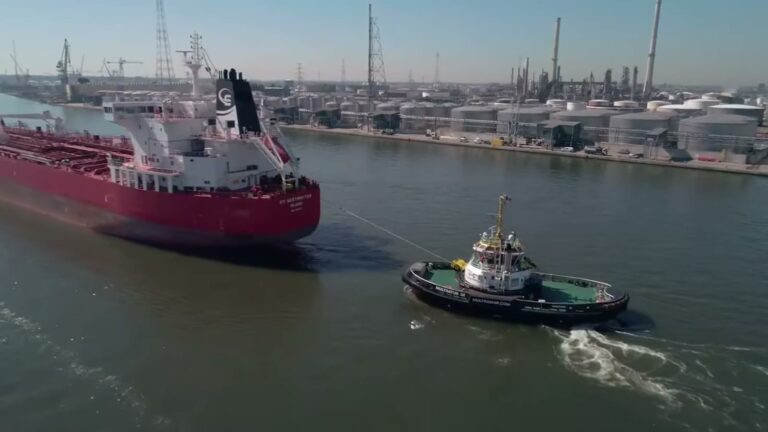
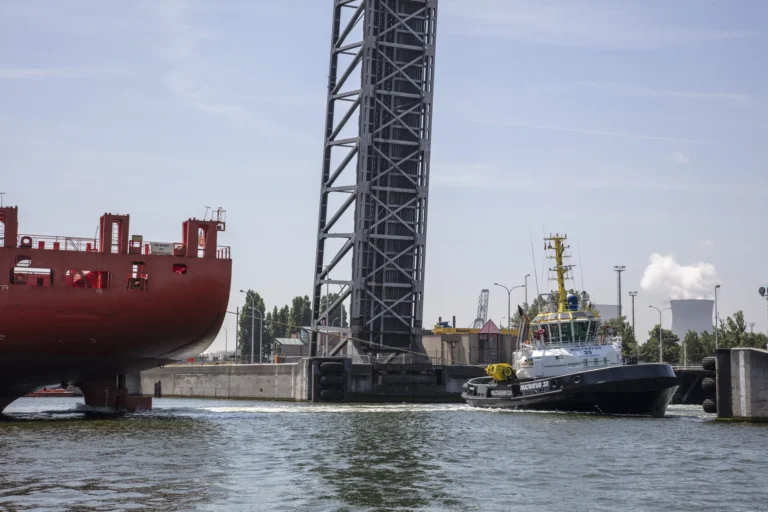
Port Authority of New South Wales states that tug allocation is assessed vessel by vessel, considering handling characteristics, thrusters, rudder arrangements, experience and prevailing conditions. IMO’s tug-assistance guidance similarly separates tug types, capabilities, environmental limits, required bollard pull, interaction and shallow-water effects. [S15] [S16]
This is why one static bollard-pull number is not a complete description of ship-assist capability. The relevant question is how much controlled force can be delivered in the required direction, at the vessel’s speed, within the available water and under the expected wind and current.
As Novatug positioning, dynamic bollard pull describes this delivered operational capability. It is not presented here as a universally standardized metric. The assessment still needs a defined manoeuvre, environmental envelope and verification method.
Fixed infrastructure and floating control should work together
A port’s response should be layered.
First, fixed infrastructure must provide the non-negotiable physical envelope: safe depth, adequate width, suitable bends, turning areas, berths and clearances.
Second, operational systems define how that envelope is used: under-keel-clearance management, pilotage, simulations, speed limits, traffic separation, weather limits and contingency plans.
Third, towage provides mobile force for steering, braking, positioning and failure response.
<figure class=”alignwide”> <a href=”visuals/03-layered-port-control.svg” aria-label=”Open Figure 3 full size”> <img src=”visuals/layered-port-control.webp” alt=”Layered diagram showing fixed infrastructure as the physical envelope, procedures and data as the operating envelope, and towage as the mobile control layer.” width=”1600″ height=”900″> </a> <figcaption>Figure 3. A resilient port combines a sufficient physical envelope, disciplined operating procedures and capable mobile control. No layer automatically replaces another. [S1] [S2] [S3] [S15] [S16]</figcaption> </figure>
Better floating control may help a port use existing infrastructure more effectively, increase operational margin or defer selected modifications. Whether it can do so is a port-specific engineering question. It should be tested through manoeuvring simulation, pilot and harbour-master review, tug-force analysis and defined operating limits.
How the CRT changes the vessel-control proposition
The Carrousel Rave Tug should be assessed as Novatug’s proposed mobile-control layer, separate from the independent evidence above.
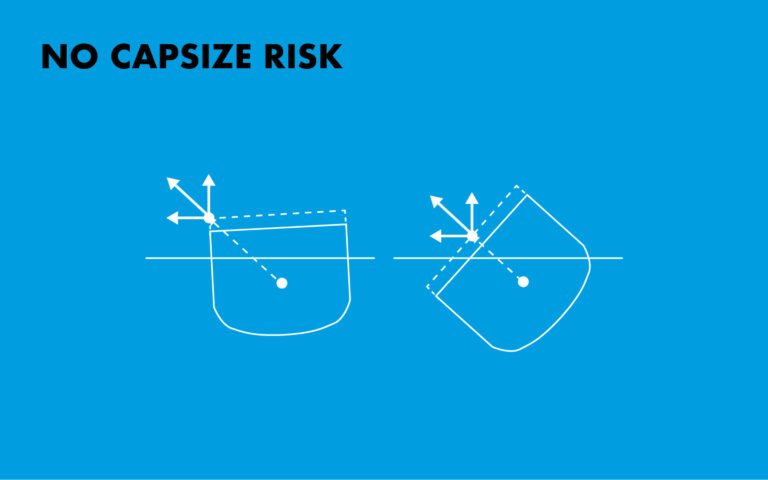
The CRT uses a towing point that rotates around the tug’s superstructure. Novatug states that this geometry gives the tug freedom to work at changing towline angles and allows its hull to generate hydrodynamic braking and steering forces while the assisted vessel is moving. [S17]
That proposition is relevant to mega-ships because momentum is both the problem and a potential source of control force. Instead of treating the tug only as engine thrust attached to a towline, the CRT is intended to use water flow around its hull to generate controlled towline force.
This is the basis for describing the CRT as floating infrastructure and an infrastructure lifespan extender. The wording is positioning, not proof that a CRT can replace a specified channel project. A defensible assessment would ask where improved steering and braking can add margin after the port’s depth and geometry requirements are satisfied.
Frequently asked questions
Can better towage replace necessary dredging?
No. If a vessel cannot maintain safe under-keel clearance, towage cannot make the water deeper. Better towage addresses control, not the ship’s physical draught.
Does widening count as dredging?
It can involve dredging, but it solves a different problem. Deepening creates vertical clearance. Widening creates horizontal manoeuvring and passing clearance. Bend widening and turning-basin enlargement are further distinct interventions.
Does deeper water make a ship easier to handle?
It can. Additional depth may reduce squat and some shallow-water handling penalties. It does not remove the need to assess stopping, wind, turning space, bank effects and tug assistance.
Why are larger ships appearing at ports that were not built for them?
New mega-ships enter major routes and displace older large vessels to secondary routes. This cascading progressively increases the vessel size presented to regional ports. [S6] [S8]
What should a port-specific assessment include?
At minimum: design-vessel dimensions and loading cases, UKC, channel and bend geometry, turning areas, wind and current limits, stopping and low-speed handling, traffic scenarios, tug allocation, delivered force in the planned manoeuvre and contingency cases.
Sources
- [S1] PIANC, Harbour Approach Channels – Design Guidelines, 2014.
- [S2] USACE, Planning and Design of Navigation Projects, EM 1110-2-1202, 1987.
- [S3] AMSA, Under-keel clearance management.
- [S4] IMO, Resolution MSC.137(76): Standards for Ship Manoeuvrability, 2002.
- [S5] UK MCA, MGN 301 Amendment 1, Appendix 2, updated 2025.
- [S6] UNCTAD, Review of Maritime Transport 2019, 2019.
- [S7] UNCTAD, Bigger ships and fewer companies, 2021.
- [S8] OECD/ITF, The Impact of Mega-Ships, 2015.
- [S9] USACE Charleston District, Charleston Harbor Post 45.
- [S10] USACE Savannah District, Savannah Harbor Expansion Project.
- [S11] USACE Savannah District, What is SHEP?.
- [S12] USACE Savannah District, SHEP Final Environmental Impact Statement, 2012.
- [S13] USACE Jacksonville District, Jacksonville Harbor Deepening, 2025.
- [S14] Port of Melbourne, Container Capacity Review, 2026.
- [S15] Port Authority of NSW, Sydney Harbour Pilotage and Harbour Master’s Directions, updated 2025.
- [S16] IMO, Ship/Port Interface: Availability of Tug Assistance, 2021.
- [S17] Novatug, Carrousel Rave Tug technical page.
Related Novatug reading and CTA
Read Hidden Capacity: Why Port Capacity Is Also a Control Question, The Cascade Is Already at Your Berth, Towage Belongs in the Port Safety Case, or how static and dynamic bollard pull differ. Explore the forces and manoeuvres available to the CRT or review the Carrousel Rave Tug design.
For a defensible decision, assess the complete port system rather than one intervention in isolation. Contact Novatug for a port-specific technical assessment covering vessel envelope, channel geometry, operating limits and towage capability.