Summary
An escort tug controls a moving vessel by converting towline tension into a steering force, a braking force or a combination of both. The result depends on the assisted vessel’s speed, the tug’s position and heading, the towline connection, water depth, environmental conditions and the tug’s propulsion and hull characteristics. Static bollard pull remains a useful certified baseline, but it does not describe this complete operating condition. [S1] [S2] [S3]
Escort capability therefore needs to be assessed for a defined passage and manoeuvre. The central question is not simply how much a tug can pull while stationary. It is how much controlled force the tug can apply in the required direction, at the vessel’s actual speed, while keeping the tug and towline arrangement within safe limits.
Key takeaways
- Steering force acts across the assisted vessel’s direction of travel and changes its course.
- Braking force acts against the direction of travel and reduces speed.
- Tug position and towline angle determine how total line force is divided between steering and braking.
- Water flow around an escort tug’s hull can contribute hydrodynamic force at speed; the effect is specific to hull, speed and operating angle.
- Static bollard pull, dynamic line force and escort steering or braking force are related but not interchangeable measures. [S1] [S2] [S3]
- Near critical infrastructure, a suitable tug may need to be connected before a failure occurs if there is insufficient time to approach and make fast afterwards. [S4] [S5]
What escort control means
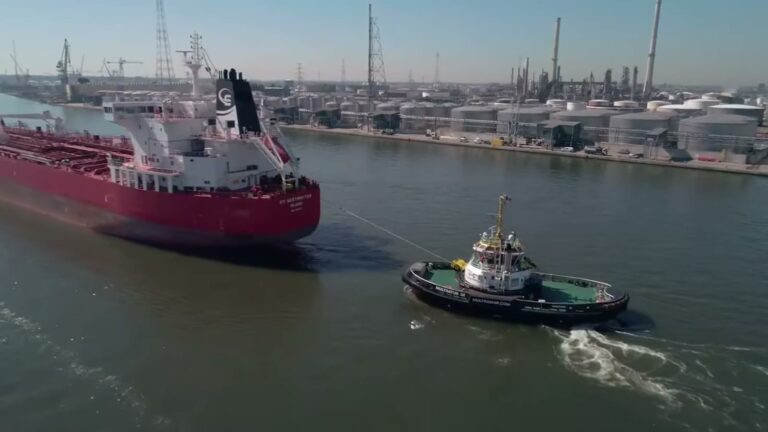
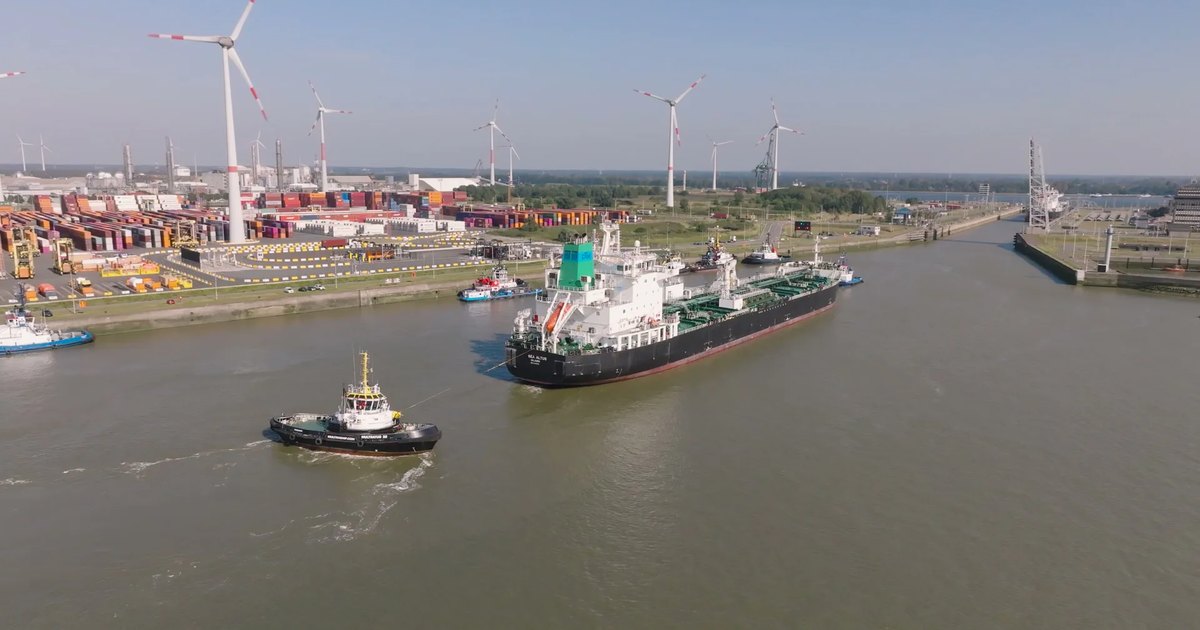
Escort towage is the use of one or more connected tugs to influence a ship while it still has way. Depending on the passage, the tug may support routine course keeping, help control speed, increase the available turning moment or provide an immediate response after loss of propulsion or steering.
The tug does not control the ship independently. The result comes from the combined system of ship, tug, towline, pilotage plan, environmental conditions and available waterway. A force that is useful at one speed or towline angle may be less useful, or unsafe, at another.
Classification rules reflect this distinction. DNV provides for escort rating numbers established through full-scale testing or numerical methods, while IMO stability provisions distinguish towing and escort operations and require the towing arrangement and maximum continuous pull to be documented. [S2] [S3]
Steering force and braking force
Towline force can be resolved into two operational components:
- Steering force acts laterally relative to the assisted vessel and creates a turning moment.
- Braking force acts against the vessel’s direction of travel and reduces its momentum.
If the tug works mainly to one side, a greater share of the line force can contribute to steering. If it works more directly astern, a greater share can contribute to braking. Between those positions, the tug can provide a combination of both.
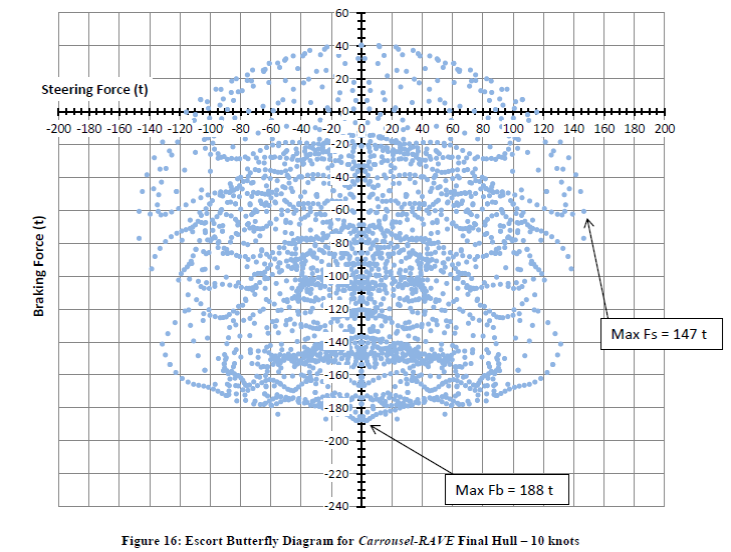
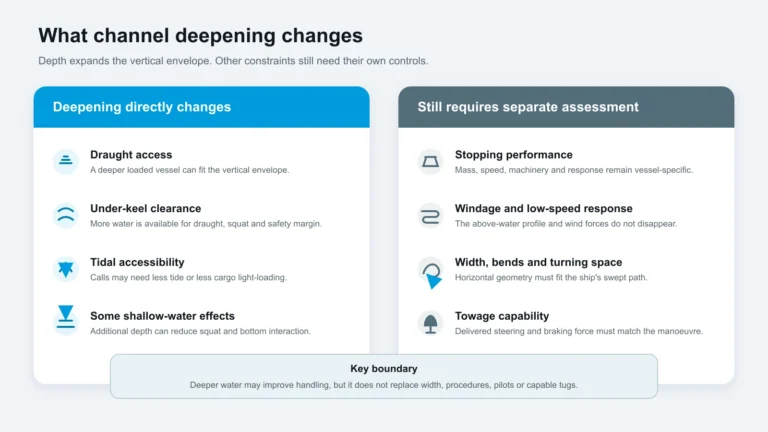
This is why a single maximum force value is not enough for an escort decision. A port needs to know the force envelope: how steering and braking change across tug angles and vessel speeds, and which parts of that envelope are operationally safe.
Where the force comes from
At zero or very low speed, propulsion is usually the dominant source of tug force. As speed increases, water flow around a suitable escort-tug hull can generate additional hydrodynamic lift and drag. The tug’s propulsion then controls heading and position while the hull contributes to the towline force.
The amount and direction of that contribution depend on hull form, speed, angle of attack, under-keel clearance and the tug’s ability to hold the required attitude. It should therefore be demonstrated through full-scale testing, validated calculation or simulation for the stated condition. [S3]
Novatug describes the Carrousel Rave Tug as using this principle. Its towing point can rotate around the superstructure while the hull is angled in the water flow, allowing the vessel to develop steering and braking force without a fixed transverse towline geometry. This is Novatug’s technical proposition and should remain distinguishable from the independent standards and operating guidance cited in this article. [S8]
Why static bollard pull is not the complete answer
A static bollard-pull trial measures sustained pull against a fixed point while the tug is effectively stationary. ABS specifies a controlled trial procedure and sustained measurement period, making the result useful for certification and comparison. [S1]
An escort operation asks different questions:
- At what ship speed must the tug act?
- In which direction is force required?
- Where is the tug connected?
- What towline angle and tug heading are safe?
- How much distance and time remain before a hazard?
- What happens if propulsion or steering is lost?
These questions require condition-specific steering and braking data. The distinction is examined in more detail in Static vs Dynamic Bollard Pull: What Escort Towage Needs to Show.
Bow and stern roles
The appropriate connection point depends on the vessel, tug type and intended manoeuvre.
A tug connected forward can contribute to heading control and may influence the bow directly. A tug connected aft can create a strong turning moment at the stern and can apply braking force along or across the vessel’s track. In an emergency, an aft-connected tug may be positioned to counter an unwanted turn while reducing speed.
Neither location is universally superior. The decision must consider propeller and thruster wash, towline lead, ship speed, tug stability, available sea room, interaction effects and the planned escape route. Port Authority of New South Wales describes tug allocation as a vessel-specific decision that considers handling characteristics, equipment, experience and prevailing conditions. [S7]
Why being connected matters near a hazard
Escort force is only available if the tug can transmit it through the towline. A nearby tug that must turn, approach and make fast may not be able to act during the first moments of a blackout.
The NTSB’s Dali factual record shows the physical problem. When assistance was requested after the loss of propulsion and steering, the ship was about 474 metres from the Key Bridge and the returning tug was about 5,095 metres away. [S5] The NTSB did not conclude that a connected tug would have prevented the casualty. The facts do show why response time and connection status belong in the local safety assessment.
UK port-safety guidance similarly requires towage procedures and emergency response to be risk assessed and reviewed with the relevant harbour, pilotage and towage stakeholders. [S4]
What the Novatug Dali simulation contributes
Novatug tested one defined scenario in which a CRT was already connected to the stern of a simulated containership before a total propulsion loss. After a modelled response delay, the tug applied steering and braking force and the simulated vessel passed through the selected bridge opening while reducing speed. [S6]
The study is not an exact reconstruction of the Baltimore casualty and does not prove what would have happened there. It demonstrates a narrower point: a connected tug can be tested as an immediate control layer under stated assumptions. Read the full Dali CRT simulation study for its inputs, result and limitations.
What a defensible escort assessment should state
An escort plan or performance claim should identify:
- The assisted vessel, loading condition and speed range.
- The waterway geometry, depth and environmental limits.
- The tug type, connection point and towline arrangement.
- The required steering and braking components.
- The measured, calculated or simulated force envelope.
- Tug-operating limits, escape routes and emergency-release arrangements.
- Communication, abort points and response after machinery or steering failure.
This turns escort selection from a nominal tug count into a control assessment. It also makes the result auditable by pilots, harbour masters, towage operators and ship interests.
Frequently asked questions
Is escort force the same as bollard pull?
No. Bollard pull is a useful static reference. Escort force is developed in a defined moving condition and must be separated into useful steering and braking components.
Does a faster ship always create more useful tug force?
No. Greater water flow may increase hydrodynamic force, but it also increases ship momentum, towline load and the consequences of losing position. Every tug and arrangement has an operating envelope.
Must an escort tug always remain connected?
No. Connection should be determined through a local risk assessment. It becomes particularly relevant where the distance and time after a failure are too short for a tug to approach and make fast.
Can one force figure select an escort tug?
No. The vessel, passage, speed, required force direction, tug geometry, environmental limits and failure scenarios all matter.
How does the Carrousel system change escort geometry?
Novatug states that the rotating towing point follows the towline around the tug, while the hull can be angled to create hydrodynamic steering and braking force. The performance must still be assessed for the stated configuration and operating condition. [S8]
Related reading
- Static vs Dynamic Bollard Pull: What Escort Towage Needs to Show
- Near Critical Infrastructure, a Tug Nearby Is Not Enough
- How Tug Girding Can Lead to Capsizing
- Simulation Study: Could a Connected CRT Have Helped Prevent the Dali Collision?
For a passage-specific escort assessment, contact Novatug to discuss the vessel, waterway and required control envelope.
Sources
- [S1] American Bureau of Shipping, Guidelines for Static Bollard Pull Test Procedure, 2024.
- [S2] International Maritime Organization, Resolution MSC.415(97): Amendments to the 2008 IS Code, 2016.
- [S3] DNV, Rules for Classification: Ships, Escort Tug notation, 2017.
- [S4] UK Department for Transport and Maritime and Coastguard Agency, A Guide to Good Practice on Port and Marine Facilities, updated 2025.
- [S5] US National Transportation Safety Board, Dali Nautical Operations Factual Report, 2025.
- [S6] Novatug, Simulation Study: Dali Collision, 2024.
- [S7] Port Authority of New South Wales, Sydney Harbour Pilotage and Harbour Master’s Directions, updated 2025.
- [S8] Novatug, Carrousel Rave Tug technical page.